
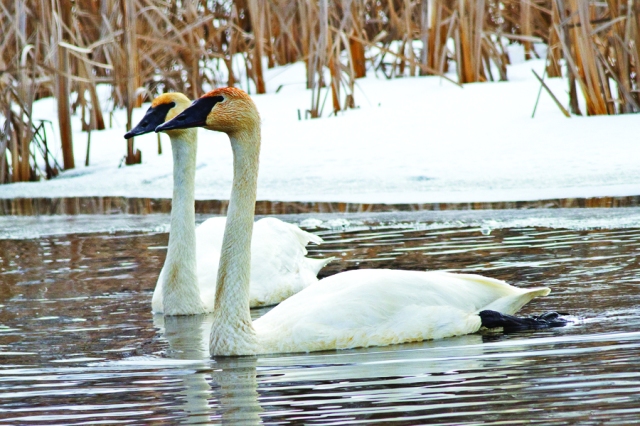
Trumpeter Swans populations are becoming more abundant. Photo by Roger Eriksson.
By Howard Meyerson
Fifty years ago the plight of Trumpeter Swans was a cause for concern in North America. The majestic birds were perched on the brink of extinction. America’s largest waterfowl species was in need of a helping hand.
Today their status has greatly improved due to reintroduction efforts by government wildlife agencies, conservation organizations, Indian tribes, and public utilities. Their numbers have increased across much of the continent. Reintroduction work continues in some locales. But here in Michigan the Trumpeters are doing very well; their recovery is a significant conservation success, according to state officials.
“This still needs to be vetted within the agency, have a public review, and be finalized by the legislature, but we will recommend in the next 12 to 18 months that the Trumpeter Swan be removed from the Michigan Threatened and Endangered Species List,” said Dan Kennedy, the endangered species coordinator for the Michigan Department of Natural Resources. “Their population made a drastic upswing between 2000 and 2010.”
Approximately 756 Trumpeters now inhabit Michigan waters, according to DNR survey records, a dramatic change from none in 1986 when the state’s swan reintroduction efforts began. Michigan’s recovery goal was modest: having two flocks of 100 swans each by year 2000. That goal was reached in 1997, according to Kennedy. It was accomplished by rearing and later releasing two-year-old Trumpeter Swans at select locations around the state. Continue reading







 The Outdoor Journal