
Howard Meyerson
After more than 30 years in the outdoor writing business, you would think I'd know better.
Signs Change on Michigan Snowmobile Trails

Riders will see new signs on Michigan trails while many old familiar ones have been eliminated. Photo: MLive files.
By Howard Meyerson
Snowmobilers can expect to see major changes on Michigan’s 6,500 mile snowmobile trail system this winter. Many familiar signs have been taken down and a handful of new signs have been installed.
State officials say the move should slow riders down.
“This began three years ago. There was no one accident or recommendation from law enforcement. People just started talking about it,” said Richard Kennedy, a Michigan Department of Natural Resources trail Operations specialist. “Ontario did away with most of their signs in (recent) years. The opinion was that people kept their speed up because of the signs.”
Bruce Wood, the president of the Michigan Snowmobile Association said the new sign system is ready for prime time. MSA is one of several organizations that participated on a Michigan Department of Natural Resources group convened to update Michigan’s snowmobile and off-road-vehicle trail signage system.
“In the long run, we hope to see a reduction in (snowmobile) crashes,” said Wood, of Charlevoix. “We’re doing what we can do get the word out, but there are still too many people who don’t know about the change and won’t when they take their first ride.”
State records show 16 snowmobilers died on the trails in the 2011. There were 13 deaths in 2010, the lowest number in 20 years. Both years were considered mild winter conditions with shorter riding seasons. There were 26 deaths during the 2009 season. Continue reading
Posted in Uncategorized
Tagged DNR, Michigan Snowmobile Trails, Signs, Snowmobile, Trails
Leave a comment
I feel better now

Posted in Uncategorized
Tagged Apocolypse, Mayan Calendar, Oreo Cookie, Photos, Prophacies
1 Comment
Keeping it Simple: State forest rustic camping reservation program scaled back

A camper prepares dinner at a lake-shore site at Houghton Lake State Forest Campground. The campground is the most popular one in the state forest system. MLive File Photo
By Howard Meyerson
What sounded like a good idea to state officials last May — allowing campers to reserve sites at 16 rustic state forest campgrounds — didn’t turn out to be the bargain some thought it might be.
Campers complained about the added costs. They didn’t find the service useful, according to Michigan Department of Natural Resources officials, who say the rustic-camp reservation program will be scaled back for 2013.
“The majority (of campers) were not excited about it,” said Tim Schreiner, manager of Traverse City State Park and the man appointed to usher the state forest campground program into a new era.
Administration of the program was shifted last spring from the DNR’s forest resource division to its parks and recreation division, which manages state parks.
“A lot of customers said, ‘Why spend eight dollars for a reservation when the campground wasn’t filled up to begin with?’ They would rather we didn’t do reservations. They didn’t see a need for it,” Schreiner said.
Reservations will be accepted next year only at four locations. Those sites are the rustic cabins at Little Presque Isle in Marquette County, Elk Hill Trail Camp and group camping in Pigeon River Country, Lake Margrethe State Forest Campground in Crawford County and Big Bear Lake/Big Bear Point State Forest Campground in Otsego County.
The change, in many respects, could have been predicted. Reservations for the remote campgrounds seemed a bit like overkill, a well-intended carryover from the service-intensive orientation at their more highly developed kin, state parks. But the allure of state forest campgrounds is their simplicity. Continue reading
Gear Review: Hilleberg Nammatj3 is light and spacious

Seems I am always in the market for a new tent. And Hilleberg is one of those brands I often think would be nice to own. The company has a sterling reputation, but their tents are anything but cheap.
This Nammatj 3 looks like an optimum mix of weight and space: less of the former, more of the latter. It is a tunnel tent and not free-standing, but company pitches it as a good tent for high or low country use and light enough to be used backpacking while spacious enough to be used car camping. That’s two tents essentially for the price of one.
Oh, and the price tag is $650, hardly inexpensive even for a 3 person tent, nor affordable for most, but it may be close if you are a two tent family. There is a two-person model available too.
This review from Outdoor Gear Lab is worth a read if you are looking for a versatile two or three person tent with a gigantic vestibule.
Posted in Uncategorized
Tagged Backpacking. Nammatj, Camping, Gear Reviews, Going Light, Hilleberg
Leave a comment
Firearm Deer Season: Hunters did well, more participated
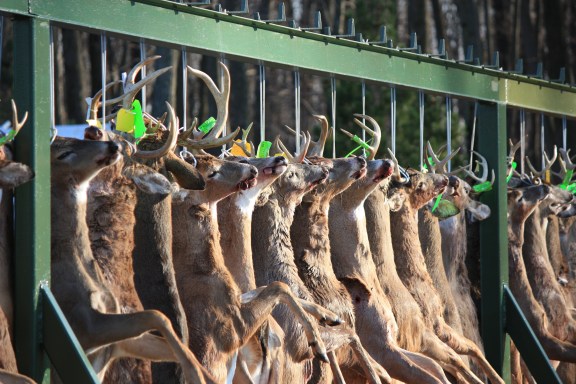
Business was booming at the Jerome Country Market buck pole during opening week of Michigan’s firearm deer season. Photo courtesy of Fred Glowe
By Howard Meyerson
Michigan’s two-week firearm deer season proved a good one for hunters, despite the EHD outbreak that killed thousands of deer in southern Michigan. More hunters participated and many did well.
“Our license sales were about 2 percent higher than 2011,” said Brent Rudolph, the Michigan Department of Natural Resources deer program specialist. “As of Nov. 18, that number was 671,000.”
Rudolph had forecast fewer hunters than last year based on a steady downward trend in recent years. More and more hunters have shifted their attentions to the archery and muzzleloading deer seasons.
But firearm deer hunting is a powerful tradition in Michigan, and this year’s Thursday opener presented hunters with some time to travel north.
“We sell more licenses when the season opens on Saturday, but we get the greatest northern activity when it opens on a Wednesday or Thursday,” Rudolph said. “People take a couple of days and go up to camp and hunt.” Continue reading
U.P. Brook Trout: Five streams will have 10 fish limits
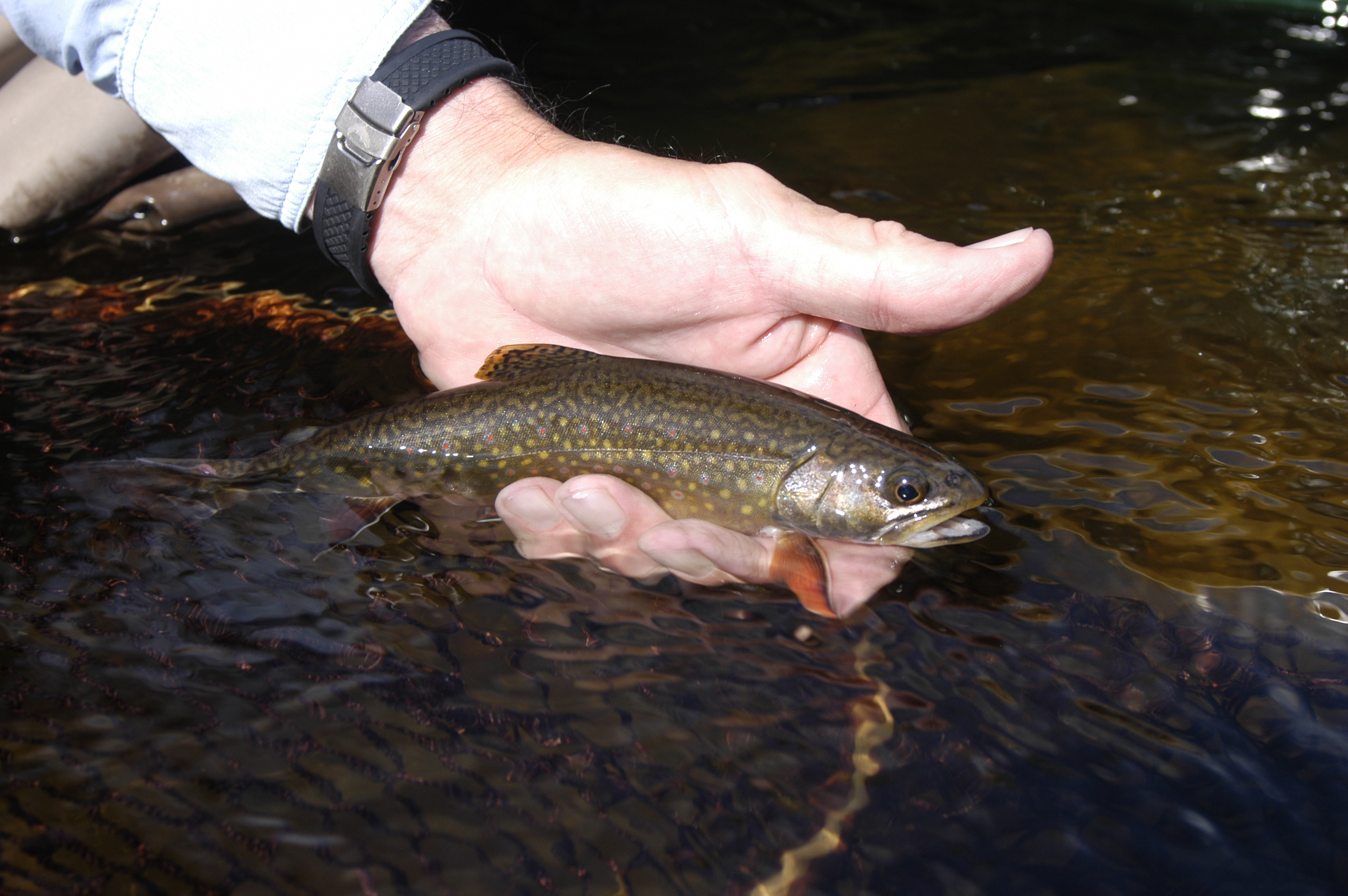
Anglers can keep 10 brook trout on five expeimental U.P. streams. Photo: By Howard Meyerson
By Howard Meyerson
Michigan will have five experimental Upper Peninsula trout streams in 2013 where anglers can keep 10 brook trout per day rather than the current limit of five.
That change was approved by Michigan Department of Natural Resources director, Keith Creagh last month after angling groups opposed an earlier proposal to create a new Type V stream classification where the higher limit would be allowed on 10 U.P. streams.
“It ended up being a good compromise,” said DNR fisheries chief, Jim Dexter. “We’ll have five streams next year where we can start work (studying the impact of the new regulation) and then we will select three more to add in 2015 for a total of eight. This gives us time to discuss which streams may be good.”
The five experimental streams currently are classified as Type I streams. The new rules begin April 1, 2013 for portions of the Dead River in Marquette County, Driggs River in Schoolcraft County, East Branch Ontonagon River in Houghton and Iron Counties, East Branch of the Tahquamenon River in Chippewa County and East Branch of the Huron River in Baraga and Marquette counties. Maps and boundary descriptions are available at www.Michigan.gov/fishing
The compromise was received favorably by conservation groups that had opposed the Type V proposal. Many had been shocked by the agency’s decision to go forward with the Type V classification. It ran counter to what they had been told. Continue reading
Dam Removal: Toxics migrate upstream with Great Lakes fish

Brook trout with salmon eggs pumped from its stomach. Photo courtesy of University of Notre Dame
Here’s a scenario. You catch a brook trout in a seemingly clear and clean stream. There is no industry to speak of, but the stream is open to Great Lakes salmon that come up and spawn and die in the fall.
What are the chances of that brook trout being contaminated with nasty chemicals? The answer is they just might be, according to a story in Science Daily today that reports on University of Notre Dame research that found that the unintended consequences of allowing Great Lakes migratory fish to pass upstream can be a transfer of the contamination from salmon to say, a brook trout – and your dinner.
Salmon accumulate a variety of toxic chemicals during their stay in the Great Lakes, particularly near big urban centers. Those chemicals are left behind upstream in both their rotting bodies after death and in their eggs which brook trout eat.
As Michigan moves ahead with dam removal projects on Great Lake tributaries like the Boardman River, this is an issue that will come into ever-sharper focus. And it should. As the story suggests, we have fish consumption advisories for salmon, but not for stream fish.
What is safe and how many and how often? Those questions are likely to come up more and more. Read more: Migrating Toxics in Fish
Posted in Uncategorized
Tagged Boardman River, Brook Trout, Dam removal, Environment, Fish, Fishing, Great Lakes, Nature, Salmon, Toxic Chemicals
Leave a comment
The Other Red Meat: Traverse City man sells packaged venison to foodie cooks, hunters
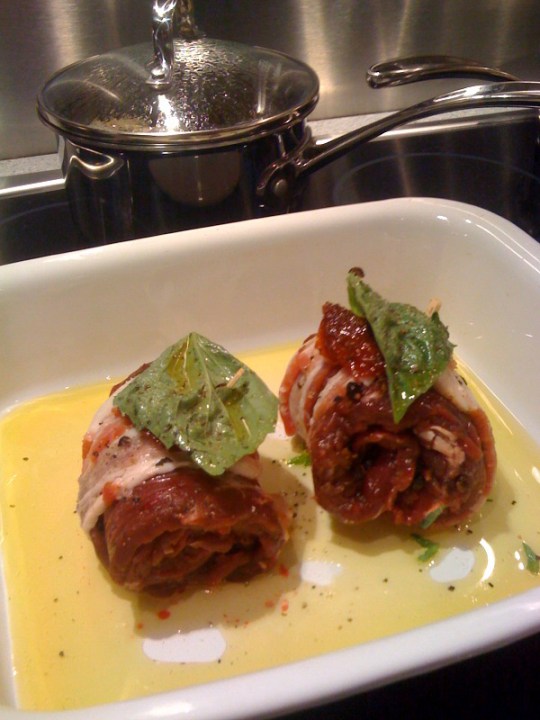
Great meal: Venison tenderloin stuffed with sun-dried tomatoes, pine nuts, olive oil, basil and wrapped in bacon. Photo courtesy of Michigan Venison
By Howard Meyerson
I’ve eaten a lot of venison over the years. Some of it was very good. And, some of it was really bad.
Venison is one of those tricky meats. The outcome depends on how well it is cared for in the field, how carefully the deer is butchered and the finesse that goes into cooking it.
I’ve eaten a lot of nondescript venison, as well as some spectacular venison salami. Hunters, it seems, often stew the meat or cover its flavor with some overly bland sauce.
But venison also can be exquisite — I mean as good as any fillet — and rightfully could be called the other red meat — but without the health issues associated with beef.
One of the best venison meals I have had turned out to be fresh road kill. An old friend came by a deer he saw get hit. The deer ended up hanging in his Heritage Hill garage in Grand Rapids, where he butchered it with great care.
And dinner that night — wow — it remains one of the finest venison entrees I have had: wonderfully cooked medium rare back strap slices, with a fine, wild mushroom and red wine sauce complemented with an excellent bottle of Cabernet. That venison meal scores up with best meals I’ve had.
“The No. 1 rule is not to overcook venison,” said Eric Villegas, owner of Michigan Venison in Traverse City. “It is a lean and healthy meat. You have to cook it more accurately. It needs to be served medium rare or rare. Then, you find out how delicious it is.” Continue reading
Posted in Uncategorized
Tagged Chefs, Cooks, Eric Villegas, Foodies, Hunters, Hunting, Michigan Venison, Venison, Wild Game Cooking
4 Comments
Wetlands: Federal Conservation Bill Dealt a Major Setback

Conservation and gun advocates were dealt a hammer-blow Monday when the Federal Sportsmen Bill suffered a major setback. The bill sought to authorize the U.S. Department of Interior to raise the cost of the federal duck stamp from $15 to $25 at its discretion, according to a story this week on Politico.
The money would have been used for wetland conservation. There was no impact on the federal deficit. It was money that sportsmen were willing to shell out from their wallets. The added revenues would have generated between $132 million and $140 million in new spending over the next decade, according to the Congressional Budget Office. The issue appears to have been a technical question of how to account for the money. Read more: Bad Blood in Congress.
Posted in Uncategorized
Tagged Congressional Budget Office, Conservation, Federal Duck Stamp, Hunting, Sportsmen's Bill, Wetlands
Leave a comment

 The Outdoor Journal