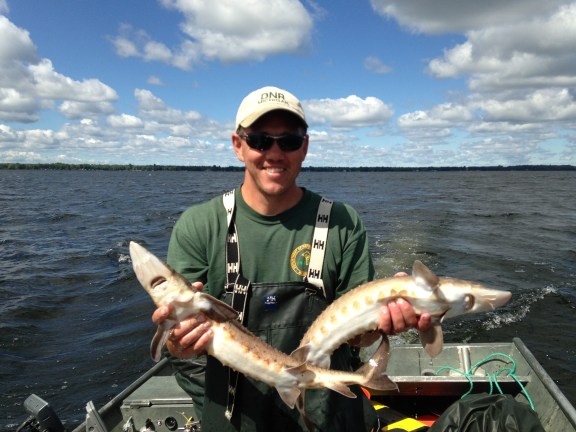
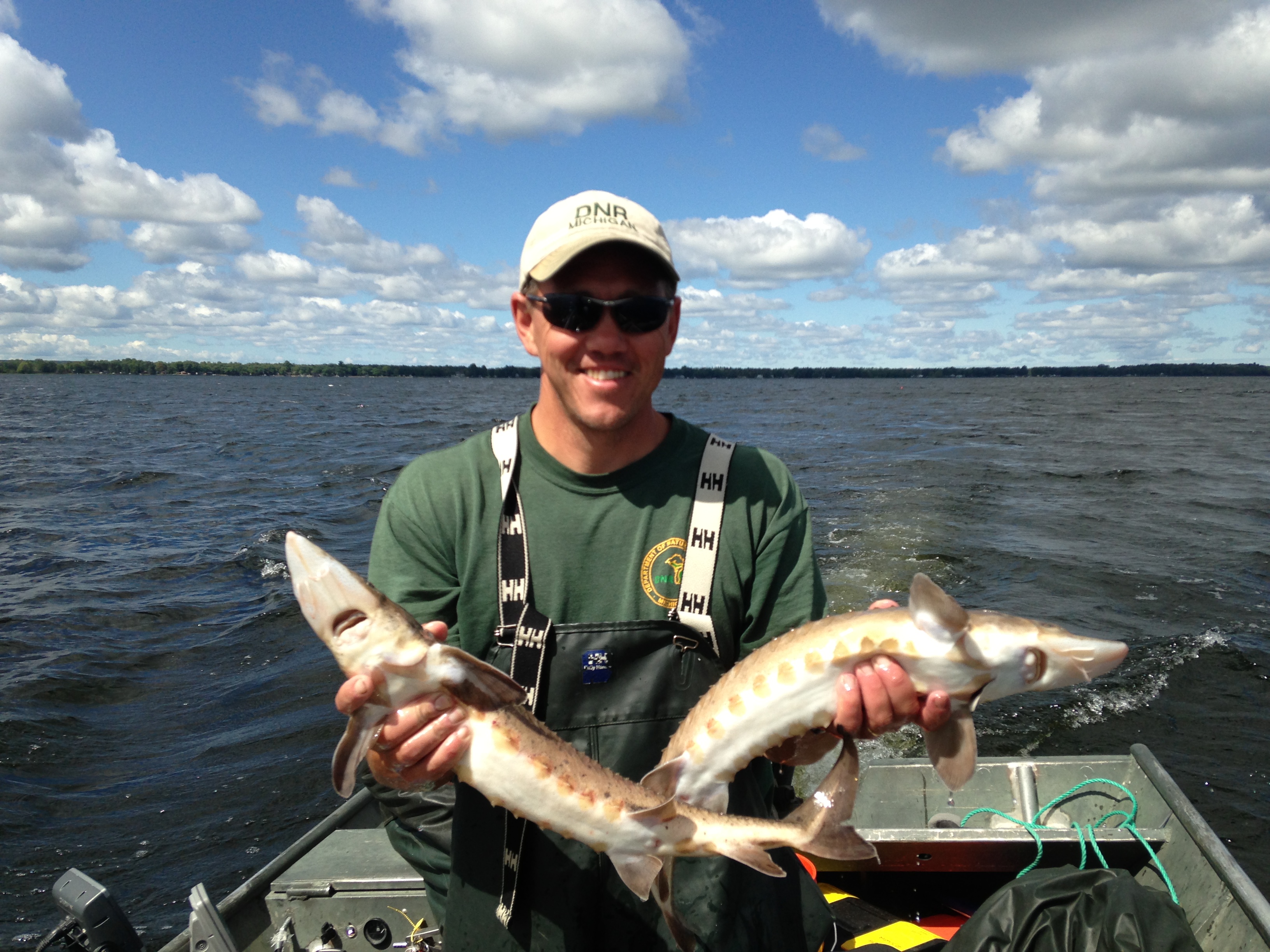
Michigan DNR fisheries staffer, Chris Schelb holds up two small sturgeon netted in Black Lake in August 2013. Photo courtesy MDNR.
By Howard Meyerson
ONAWAY, MI – Preliminary findings from a sturgeon mark-and-recapture study in August on Black Lake show that most are stocked and raised in a hatchery, a small number are wild, and a large percentage are juveniles. The netting study was done to evaluate sturgeon stocking practices and the extent of lake’s wild population, state officials said.
“What surprised me was to find so many juveniles,” said Dave Borgeson, the Northern Lake Huron Unit supervisor for the Michigan Department of Natural Resources. “We weren’t entirely sure how well we could implement the survey. To be able to catch so many young sturgeon– it came off as well as could be anticipated. “
The three-week netting effort was conducted by DNR crews with help from Michigan State University and the Little Traverse Bay Band of Ottawa Indians. The researchers collected 283 sturgeons. Most of those were juveniles.
The smallest was 22-inches. The largest was 71-inches long.
Ed Baker, the station manager for the DNR’s Marquette Fisheries Research Station, estimates that Black Lake contains 6,114 juvenile sturgeons from the 2009 year class or older. His estimate is statistically derived from the capture of 252 juvenile sturgeon that were less than 133 centimeters (52.3 inches) long. Smaller fish were not “susceptible” to gill-nets that were used, Baker said.
“Ongoing analysis suggests that the vast majority of juvenile lake sturgeons in Black Lake are of stocked origin,” Baker wrote in a preliminary report. “…natural recruitment is very low in Black Lake and likely not sufficient to support the population under the current management (harvest) regime.”
Baker estimated that there are 28 wild sturgeons from the 2008 year class, and 150 others from 2004, both years when the lake was not stocked. Continue reading →


 The Outdoor Journal