
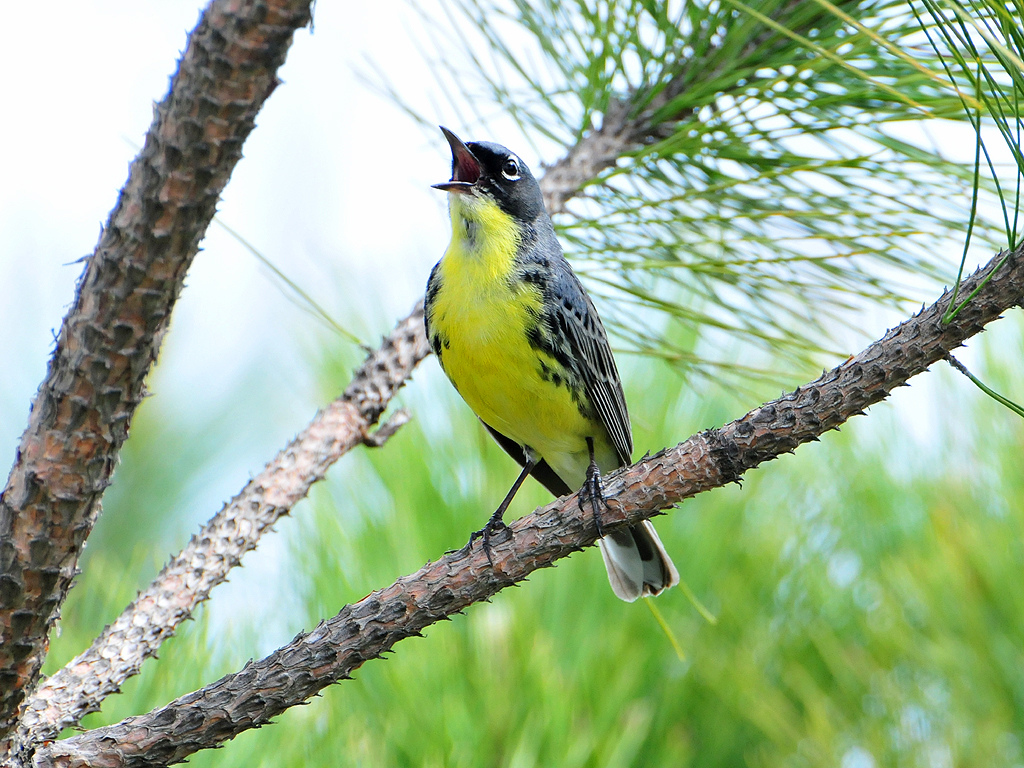
Kirtland’s Warblers are well above recovery goals in Michigan. Photo: U.S. Fish & Wildlife Service.
By Howard Meyerson
Michigan’s endangered Kirtland’s Warbler appears to be well down the road to recovery. More than 2,000 singing males were reported in Michigan’s 2013 Kirtland’s Warbler census. That was the second consecutive year that the population was double the federal recovery goal of 1,000 singing males (breeding pairs)—a world away from 1967 when the bird was added to the federal Endangered Species List, or when its populations reached record lows in 1974 and 1987 and only 167 were found.
While the warbler’s rebound is reason for celebration, federal and state wildlife officials and Michigan’s conservation community remain concerned about its future. Successful recovery brings talk of removing it from the Endangered Species list, a decision that places the gray-blue and yellow warbler at a crossroad with respect to its future survival.
“This is a conservation-reliant species that continues to depend on our future action,” says Dan Kennedy the endangered-species coordinator for the Michigan Department of Natural Resources (DNR). “That’s why having a plan is so important.”
Kennedy is one of several who are working on a Kirtland’s Warbler Conservation Plan. He is coordinating that cooperative effort between his agency, the U.S. Fish and Wildlife Service (USFWS), and Huron-Manistee National Forest. The plan is to be released for public review this summer. It will guide future management and replace the federal recovery plan once the bird is delisted.
Delisting, however, is not an automatic step, according to federal officials. Known threats have to be addressed before that will be proposed. “We have two issues ahead,” notes Scott Hicks, the USFWS field supervisor in the East Lansing field office. “One is to assure an adequate supply of appropriate-aged habitat, and making sure there are commitments to manage for that. The second is cowbird control.”
The USFWS pays for cowbird control, an annual effort to trap thousands of the parasitic birds that threaten the warblers by laying eggs in their nests. Studies show the presence of cowbird chicks, which are larger, more aggressive, and outcompete for food, results in poorer warbler survival. The cost for trapping is approximately $100,000 a year. “It is paid for by endangered species recovery funding,” Hicks said. “If we delist the Kirtland’s Warbler, that funding will be redirected to other species. We will need another way to cover the costs.” Continue reading










 The Outdoor Journal