

Yet another use for ferns.
Yet another use for ferns.
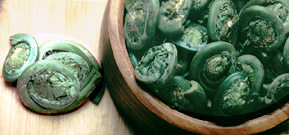
Wild edibles like fiddlehead ferns are both delicious and easy to collect on the trail.
Fiddlehead ferns are easily collected on the trail and make a delectable dish in camp at night, or at home. They are readily sautéed with a little garlic and butter.
Plan on seeing them any time into May. I’ve picked them fresh while backpacking and made an excellent side dish to go with the evening meal. They taste a lot like asparagus. Here’s a good discussion about how to find, them and prepare them. Read more: Wild Harvest

For those who enjoy visiting spectacular cliff dwelling sites, a few special tours are on tap at Mesa Verde National Park this summer and early fall, including visits to both the Mug House and Square Tower House ruins.
These ranger-guided hikes include a 2-hour hike to Mug House, a 2-hour hike to Square Tower House, and a 4-hour hike on Wetherill Mesa offered in September. Read more: Mesa Verde
By Howard Meyerson
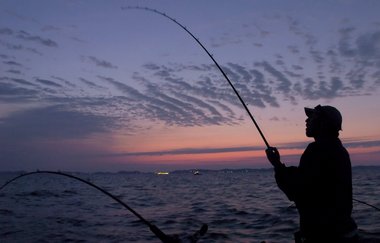
Lake Michigan salmon anglers did well during the 2011 fishing season. The Chinook salmon catch was up despite the season’s slow beginning. The fish were larger, and anglers had a blast.
In fact, anglers boated 203,000 king salmon on Lake Michigan last year, up from 188,000 the year before. And though the catch rate dropped slightly — from 11 Chinook per 100 hours of fishing in 2010 to 10.2 fish per 100 hours in 2011 — state officials still give the season a big nod.
“That catch rate is still pretty good,” said Dave Clapp, the chief of the Michigan Department of Natural Resources Charlevoix Fisheries Station. “The long-term average is around seven fish per 100 hours, though the peak has been as high as 14 or 15 fish.
“Overall, the total harvest was up, and some of that is due to increased effort. More people went out because they saw bigger fish.”
If all is well, you might ask why fish managers now want to reduce the number of salmon being stocked or reduce stocking for a combination of Chinooks and other species like coho, steelhead and lake trout.
It’s a good question. Lake Michigan is stocked annually with 2.5 million hatchery-raised Chinook fingerlings. But the Michigan DNR and other states are considering cutting that by 30 to 50 percent.
The DNR sponsored a workshop in Benton Harbor Saturday to explain the situation to anglers and to get their feedback. Other Lake Michigan states are doing the same. Each wants anglers to participate in the outcome.
“The prey biomass in Lake Michigan is at record lows right now despite a strong 2010 year-class of alewives that resulted in bigger fish last year,” said Jay Wesley the Michigan DNR’s Lake Michigan basin coordinator. “We’re still seeing really low numbers of alewives, smelt and bloater chubs. There is not much out there, and the predator prey balance is off.”
Which is another way of saying that trouble could be looming. Without enough food to eat, future salmon could be smaller, less numerous or just disappear.
“We just came off a really good year in Lake Michigan, but if you go back and look at 2003 on Lake Huron, which had the largest prey population in its history, the fishery collapsed in 2004,” said Denny Grinold, a charter fishing captain out of Grand Haven and the chairman for The Great Lakes Commission committee of advisers.
Grinold was one of three Michigan representatives on the multistate panel that began meeting last year to determine how much risk of collapse anglers could tolerate. Dennis Eade, the director of the Michigan Steelhead and Salmon Fishermen’s Association, and John Robertson, representing Michigan United Conservation Clubs, were the other two Michigan representatives.
“No one wanted more than a 20 percent risk of alewife collapse and, for some, that was too much,” Grinold said.
They also preferred not to see smaller and fewer fish.
Biologists say several things threaten the future of salmon fishing on Lake Michigan. The alewife forage base is limited. Quagga mussels are filtering out the tiny organisms that young alewives need to thrive. The lake has only six alewife year-classes. It typically has nine, and more is better since it lessens the chance of collapse should disease wipe out any one.
Ninety-five percent of the alewives were born in 2010. The big Chinooks are eating them up. No alewives were born in 2011.
“We are getting to the point of losing the older, bigger spawning fish (alewives),” Wesley said.
The good news is in salmon reproduction. DNR studies show that 50 percent of the 1-year-old Chinooks are natural. They spawn in streams and contribute to the fishery. Up to 80 percent of the mature fish also are natural, but Wesley said fish managers are less certain of the number because of difficulty in determining their markings.
“It suggests we may be over-relying on hatchery fish,” Wesley said.
That’s not a bad problem to have, one might think. The Lake Michigan salmon experiment is evolving into a self-sustaining fishery. However, more salmon means any food will disappear more quickly. And Chinook, unlike other species, eat only alewives. Hence, the cut.
Wesley said Lake Michigan states are considering four primary options to reduce Chinook stocking:
Cut by 50 percent and wait five years to make further changes.
Cut by 50 percent and monitor weights closely. If 3-year-old Chinooks weigh less than 15 pounds, more cuts might be warranted; if weights increase, so might stocking.
Cut Chinook stocking by 30 percent and other species, except lake trout, by 10 percent, then monitor and adjust. This allows the lake trout rehabilitation effort to continue.
Cut Chinook stocking by 30 percent and all other species, including lake trout, by 10 percent, then monitor and adjust.
“All four policies have to be agreed upon by all the states,” Wesley said. “We can live with any of the four.”
Can you?
Michigan and other states will be taking comments for 30 days. Anglers and others who are interested in the decision can submit comments online at miseagrant.umich.edu.
© 2012 MLive.com. All rights reserved.
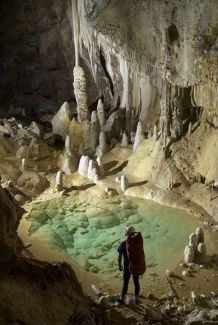 Far underground in New Mexico’s Carlsbad Cave system, scientists have discovered drug-resistant microbes, according to National Geographic, which reports that the bacteria coated the walls of a cave 1600 feet below the surface.
The discovery took place in Lechuguilla cave, one of the world’s largest and deepest caves with more than 130 miles of passage. The finding intrigues medical scientists who are studying “superbugs.”
Read more: Drug-Resistant
 There’s nothing like keeping dry when it gets nasty outdoors. But what to wear? Ah. Always a question. Over the years I’ve owned my share of shells and waterproof rain gear. Some were excellent, some only mediocre. Plastic bags only cut it during an emergency.
If you are looking for a good jacket, take a look at this review. Outdoor Gear Lab recently put several brands to the test. The Marmot Oracle got “Editor’s Choice” and the Marmot Precip Jacket was rated a “Best Buy.” Read more: Jackets for Women

The ports of Grand Haven (shown), South Haven and St. Joseph are expected to be the top perch producers again this year.
By Howard Meyerson
GRAND RAPIDS — Anglers looking for a fresh perch dinner would do well to keep an eye on southern Lake Michigan and its piers. Unseasonably warm spring weather has prompted a few early runs. State officials say perch fishing is likely to start earlier than usual, beginning any time this month.
“Everything is ahead of schedule this year because of the warm weather,” said Brian Gunderman, a Michigan Department of Natural Resources fisheries biologist at the agency’s Plainwell office. “Perch fishing is three weeks ahead of schedule. At St. Joe, they have been into the piers.
“Typically, they start moving in to spawn in late May or early June. This year, it might be late April or early May. It could May for a big run, but we may have some fish in early April.”
In fact, West Michigan anglers began reporting catches of 12-inch perch off Grand Haven on April 1. Anglers in Indiana were enjoying them earlier still.
“It’s still a popular fishery, even though it is reduced from what it was,” Gunderman said.
The lake’s perch population has been depressed since the late 1990s, so much so that the state cracked down on commercial fishing in 1996 and lowered angler creel limits. The daily limit for Lake Michigan is 50 perch, but south of the 45th parallel (excluding the Grand Traverse bays) it is 35 perch.
But creel surveys show that Lake Michigan still provides anglers with 400,000 to 700,000 perch each year. Anglers caught more than 1 million yearly in the 1980s and 1990s. The fishery peaked at more than 2 million in 1994.
The perch decline was brought on by a number of factors, including over-harvesting and depressed reproduction. The drop in perch reproduction is linked to diminished plankton levels as a result of zebra mussels. Plankton is not evenly distributed across Lake Michigan, according to state officials.
That spottiness, combined with water temperatures and varying input from rivers, accounts for occasional spikes in the catch in places such as Green Bay, Wis.
“We were hoping for 1 million fish (caught) a couple of years ago,” said Dave Clapp, chief for the DNR’s Charlevoix Fisheries Station, “but we have been bouncing around one-half million.
“There was no reproduction to speak of in 2011, but there was a good year-class in 2010.
“Anglers will start seeing those fish this year, but they will be very small,” Clapp said. “We’re expecting a moderate harvest and we may see good reproduction, depending how much it warms up.”
The ports of St. Joseph, South Haven and Grand Haven, he said, are expected to be the top perch ports again this season.
© 2012 MLive.com. All rights reserved.
By Howard Meyerson
Some of the most involved salmon anglers in the state now appear to be very nervous about forage conditions in Lake Michigan and what that means for the Chinook salmon that rely on them.
In a letter dated April 11, 2012 to Michigan fisheries chief, Jim Dexter, members of the state’s Lake Michigan Citizen’s Fishery Advisory Committee asked that the state consider a moratorium on salmon stocking for one to two years
“It is the consensus of the LMCFAC that a 5th option be considered –Stocking of Chinook salmon be stopped for a period of 1-2 years coupled with an extensive and intensive monitoring and evaluation program that could trigger stocking efforts should indicators prove necessary.
“Better to error on the side of increasing forage biomass – than a collapsed fishery. Doing too little – too late – is a path we can’t retrace,” the letter states. Continue reading
After more than 30 years in the outdoor writing business, you would think I'd know better.
Protecting Michigan's Natural Heritage Since 1952
Adventure Travel Photography Blog
Every Day is a Gift!
Walks Stories and Nature
we travel, then walk, on a budget
Information and discussion on legislation of interest to Michigan paddlers
News and Views of the Outdoors
Reclaiming the Raisin-Grand Water Trail
Drink Local, Eat Local, Create Local
October 11 & 12, 2014 in Calhoun County, Michigan
Michigan's Premier Trail Resource
A great place to explore
All things eBird in Michigan
Just another blog
Explore. Fish. Hunt. Live
Gail Mooney - Insights from a professional photographer and filmmaker


 The Outdoor Journal