New Report: Pharmaceuticals in drinking water, serious concern

Pharmaceuticals in drinking water has become an issue in recent years. It takes 99 years for them to leave, according to a new report by the Alliance for the Great Lakes, a story in Great Lakes Echo reports today. They end up in the water from animal and human waste along with people flushing them down toilets.

Of 20 priority chemicals being examined, only fire-retardant remained in the water. I suppose that’s better news than might be, but I suspect that fire-retardant is good for no one. Wildlife and fish are also affected, according to the story.

“A 2009 Associated Press investigation discovered that at least 41 million Americans drink water with detectable levels of pharmaceuticals. Often water reports do not reveal results of pharmaceutical tests, the investigation discovered,” the story reported.

Read more: Bad Stuff in the Water.

Posted in Uncategorized | Tagged , , , , , , , | Leave a comment

Nanoparticles in fish cause performance to decline

Now this is something I find troubling – right up with flushed hormones and human pharmaceuticals entering the water course. Nanoparticles made of titanium dioxide are affecting fish performance. They don’t swim as fast as normal. Scientists say the particles get into fish gills and cause oxygen deprivation.

“We’ve shown that nanoparticles have similar effects on fish to trace metals like copper – they produce hypoxia [oxygen starvation], which in turn leads to poor muscle performance, neurological problems and changed behavior,” an EarthSky story today reports. Nanoparticles are used in a variety of products from sunblock to socks.

This is just the start with nanoparticles.  There is a lot we don’t know and a lot more to come. Read more: Nanoparticles in Fish

Posted in Uncategorized | Tagged , , , , | Leave a comment

13th annual Fly Tying Expo at Holt

Fly tiers will be gathering in Holt on Saturday December 1 for the 13th annual Fly Tying Exposition, sponsored by The Great Lakes Council of the Federation of Fly Fishers. The expo is held at the Holt High School from 9 a.m. to 4 p.m.  The exposition is always a good show and draws top name tiers.
This year is no exception. Jeff “Bear” Andrews, Julie Nielsen, Chris Soule, Jim Reed, Dennis Potter and Gerry Worden are among those who will demonstrate how to tie various patterns and show their designs and works. Admission  is $10 for adults, $5 for children and 12 and under are free. Details can be found at: www.fffglc.org,
Posted in Uncategorized | Tagged , , , , | Leave a comment

Michigan Audubon launches backyard birding series

Looking to learn a bit about the best way to attract birds to your backyard? Michigan Audubon Society launched a new series today called “Winter Backyard Birding.” The first installment is about attracting House Finches.

The series looks like a good one, full of great tips and information about different bird species. Nyjer, black sunflower seeds and millet are the ticket. Check it out at: Winter Backyard Birding.

Posted in Uncategorized | Tagged , , , , , | Leave a comment

Lake Michigan Water Trail to Boost Tourism

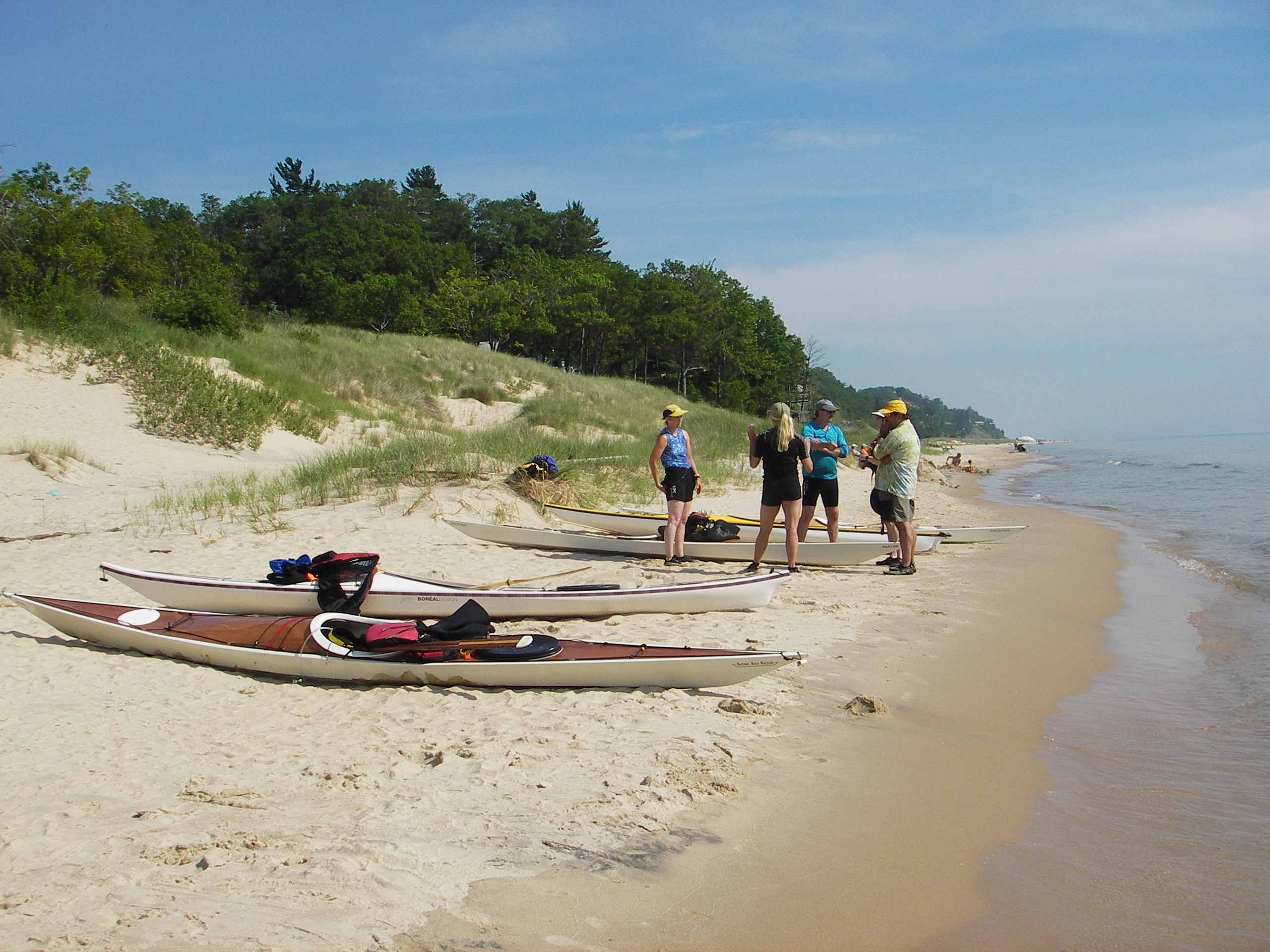
Paddlers gather along the sandy beaches of Lake Michigan, part of the 1200 mile route being developed around the lake. Photo by Howard Meyerson

By Howard Meyerson

MUSKEGON, MI – – A friend and I sat at water’s edge recently watching Lake Michigan waves roll thunderously onto the beach. They ran up the sand with the power of a freight train, pushed by the gale that had blown the beach smooth.

“What would you do if you saw someone out there,” I was asked. The answer was simple. “I’d keep an eye on them, call 911 or Coast Guard,” I replied. “There is nothing I could do when the waves are this high — and the water is this cold — other than get myself in trouble.”

Indeed, that is what would happen. The question struck home. I had just spent two days in Saugatuck at a conference about the Lake Michigan Water Trail. That’s the 1,200 mile route being developed around Lake Michigan — an ambitious four-state project with much to offer paddlers and local communities. The latter are expected to gain from the economic benefits of increased tourism.

Those benefits, by the way, are expected to amplify with the parallel development of a cycling route around Lake Michigan and the revival of the Circle Tour motor route.

The branding implications seemed abundantly clear — a case of “build it and they will come.” Paddlers down south, for instance, who might have heard of Lake Michigan but never thought to visit, would suddenly have reason to consider it.

They might bite off a small piece and paddle or cycle a segment, stay in local motels and/or camp. Or, they might go for the gusto as Mary Catterlin and Amy Lukas did this past summer. The 23-year-old paddlers from Indiana circumnavigated Lake Michigan in an 11-foot dugout canoe. Catterlin had crafted it in her parent’s backyard by hollowing out a log. Continue reading

Posted in Uncategorized | Tagged , , , , , , , , , | Leave a comment

Michigan daily salmon limit to stay at five in 2013

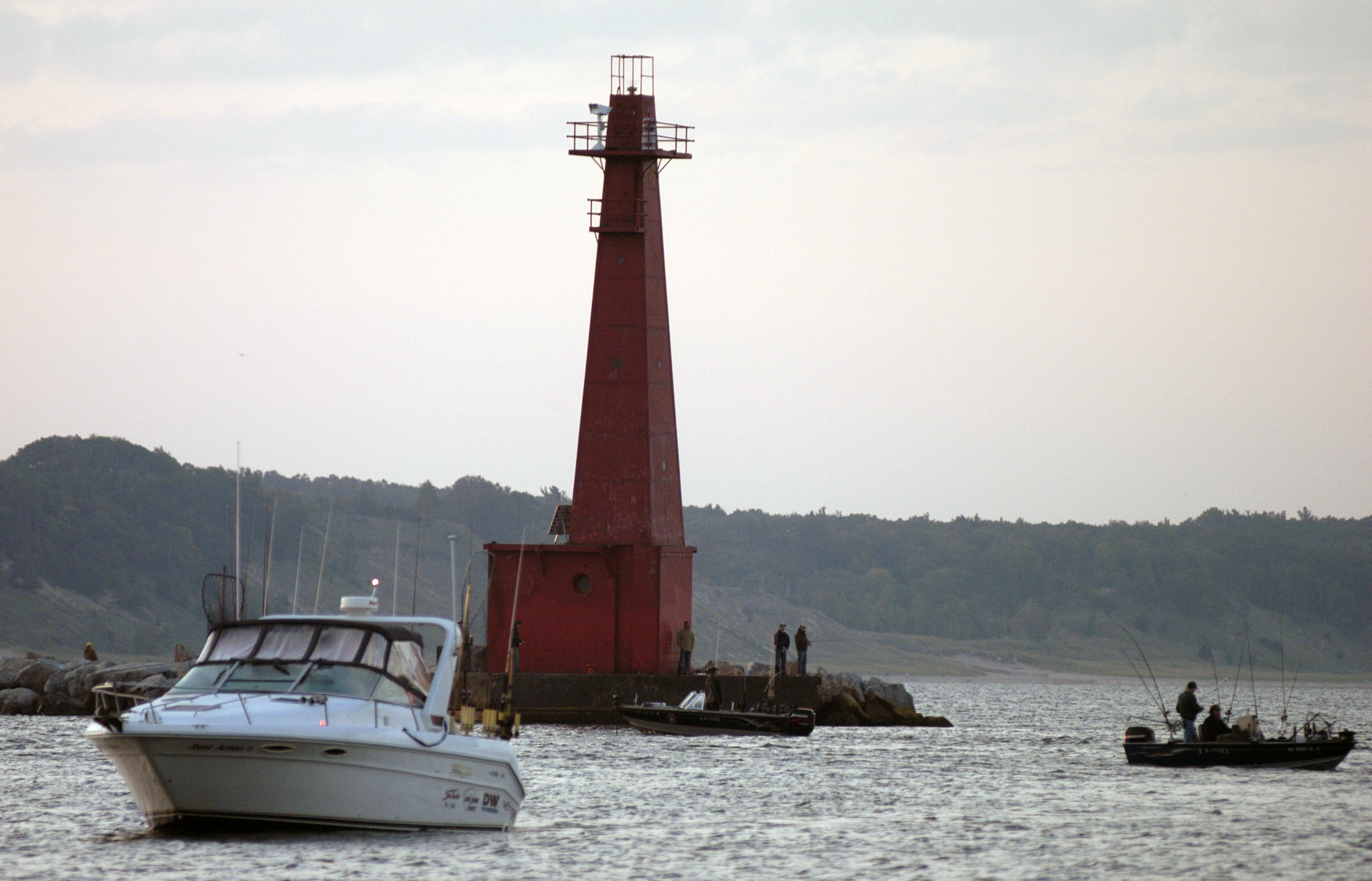
Anglers will be able to keep five salmon per day again in 2013. Photo by Howard Meyerson

By Howard Meyerson

GRAND RAPIDS, MI – Anglers will again be able to keep five salmon per day in 2013. Salmon fishing was that good this year. Many reported excellent Chinook salmon fishing throughout the summer on Lake Michigan.

But state officials remain concerned about a dwindling lake forage base. They suggest this year’s success may hint of trouble to come.

The five salmon limit will stay in place, they say, to reduce pressure on the alewife population which has been found to be at low-ebb.

“Typically we see catch rates go up when Chinooks are in prey search mode. They are more apt to grab a spoon than when there is a lot of bait out in the lake,” said Jay Wesley, the Michigan Department of Natural Resources southwest Michigan fisheries supervisor.  “It indicates the fish are on the feed more, or that there are a lot of fish out there when there is not enough bait to support them.”

Michigan raised the salmon limit to five per day limit in 2010 after limiting anglers to three for many years following the late 1980’s Lake Michigan Chinook salmon crash due to bacterial kidney disease. Continue reading

Posted in Uncategorized | Tagged , , , , , , , , | Leave a comment

Counting Cranes: Will wind energy and hunting impact state population?

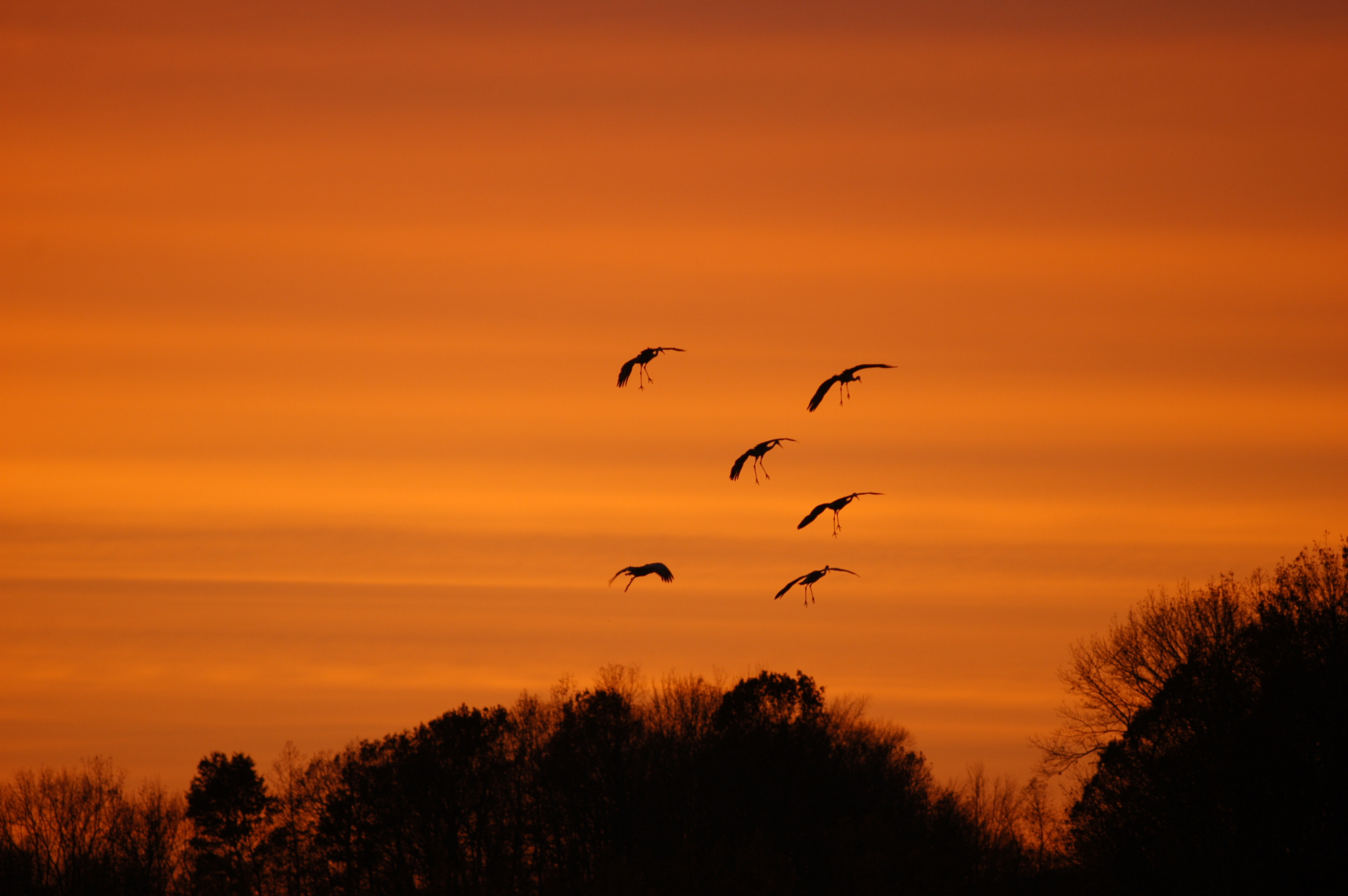
Coming in for a landing during the annual state crane count. Photo by Howard Meyerson

By Howard Meyerson

DELTON, MI — The evening sky took on a surreal quality not unlike a scene by Japanese film director Akira Kurosawa. A dull gray ceiling had transformed in just a matter of minutes to an explosion of orange, yellow and purple, flooding the lakefront with a post-apocalyptic light.

To add even more drama, there were cranes flying in. Small flocks hung in the sky over the lake, calling in their unmistakable tongue, part trumpet, part purr, part rattle and croak, a language that has fascinated man for centuries.

Standing nearby, bundled up to ward off cold, Tom Funke was counting them on a clicker he held in his hand. A pair of binoculars hung around his neck.

Funke is the director of conservation for Michigan Audubon Society. He and I had come out for the annual state crane count, an event that provides the U.S. Fish and Wildlife Service with a snapshot of migrating crane numbers. The data help them determine the status of the cranes, which are protected under the federal migratory bird treaty act.
Sandhills almost were extirpated in Michigan, having been sought by market hunters for food and by clothiers for fashionable plumage. They were common in Michigan until the 1880s. By 1905, they were nearly gone.

“We’re trying to keep track of their population and migratory trends,” Funke said. “Seventy-five years ago, there were hundreds in Michigan, not thousands. And there are recent developments that may impact cranes in the future.” Continue reading

Posted in Uncategorized | Tagged , , , , , , , , , , | Leave a comment

Innovation: World’s largest indoor ski hills

Why not build the world’s largest indoor ski dome?  That’s what Danish travel company Danski and the architectural firm CEBRA are proposing: Skidome Denmark. The 1,000,000 square foot facility would be built over a river and offer three arches, each steeper and more more difficult, according to a report today on the Adventure Journal Blog. Just another good reason to go and visit. Here’s the link to the design site: http://skidomedenmark.dk/#/

Posted in Uncategorized | Tagged , , , , | Leave a comment

Innovation: Origami inspired plastic folding kayak

The Oru kayak is a folding plastic kayak that was inspired by origami

Innovation is the name of the game and Anton Willis, a San Francisco designer, is no slouch. Drawing on his fascination of Origami, the California native has come up with a stylish and sensible solution for kayak storage when living in a small apartment: a folding plastic kayak based on Origami.

Folding kayaks are nothing new. Most are treated fabric shells with wooden or other frame pieces that snap together in some fashion inside the shell. But Willis’ design is made of a double-layer of corrugated plastic with seams he claims can be folded 20,000 times.  The frame is plastic too. Purists can, of course, recycle the whole thing when they are done with it, but I’d probably prefer to give to someone.

A story this week in Wired  takes a look at the boat and Willis’ development process.  It’s  an attractive kayak, albeit short at 12 feet long. It is somewhat beamy too at  28 inches wide and 13-inches high. The Oru Kayak, as it is called, can take a spray cover. Needless to say, it comes in a plastic carrying case. I am still waiting to find out the price. For more details on the boat here is his website: http://www.orukayak.com/

Posted in Uncategorized | Tagged , , , , , , , , | Leave a comment

Add your thoughts here… (optional)

Posted in Uncategorized | Tagged , , | Leave a comment