Recreation passport requirements change at some locales

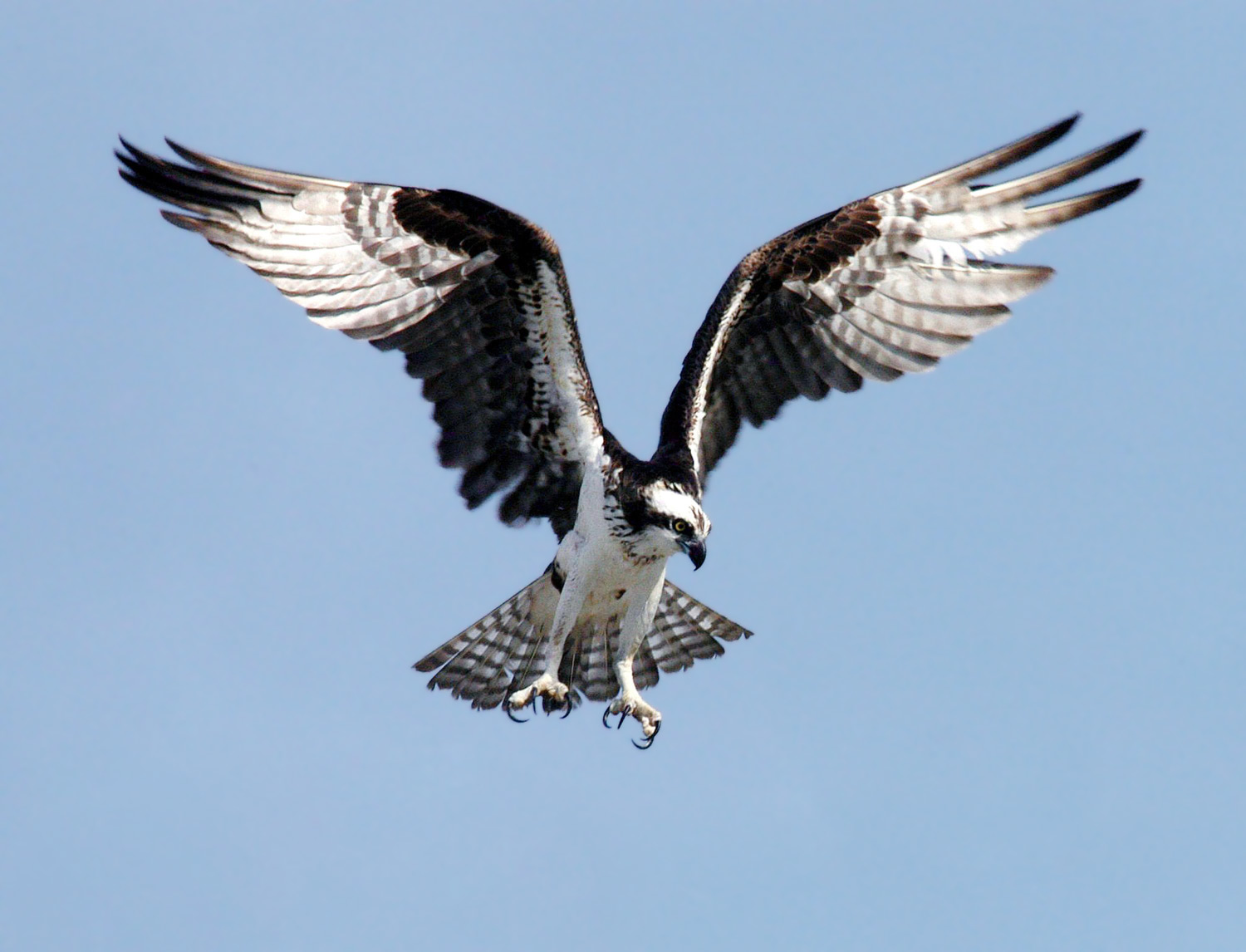
Fletcher's Pond is popular with both anglers and birdwatchers who enjoy seeing the osprey that nest on man made nesting platforms.  Photo: Wikimedia Commons.

Fletcher’s Pond is popular with both anglers and birdwatchers who enjoy seeing the osprey that nest on man made nesting platforms. Photo: Wikimedia Commons.

By Howard Meyerson

GRAND RAPIDS, MI – Anglers, birdwatchers and others who enjoy boating on Fletcher’s Pond will need a state recreation passport this year to launch on the popular 9,000 acre flooding in Montmorency and Alpena counties. Michigan DNR director, Keith Creagh, approved a staff proposal in early February to require a passport for access there and six other state parks, recreation areas and boat launches. Creagh also eliminated the need for passports at three state forest campgrounds and a Mecosta County boating access site.

“Fletcher’s Pond is busy all year-long,” said Anna Sylvester, the DNR’s northern Michigan field operations section chief for its Parks and Recreation division. “Parking there is out of control. There were no fees, but we knew we would need to start staffing it to get the parking under control. So a passport will be required, which will help cover the cost of staffing.”

State recreation passports cost $11. The can be purchased on site or when license plates are renewed each year. The Passport provides free access to state parks, state recreation areas, state forest campgrounds, and more than 70 boating access sites.

Sylvester said the passport requirement was added at sites where staffing and other work will be needed. It was removed at sites where local government or other private concessionaires were taking over operations.

“Fletchers will be staffed on the weekends, and during the week it could be spotty, but there it will have a self-registration tube where people can buy a passport. They just need to keep the receipt, and we will send them one. If staff is there they can buy a passport from them,” Sylvester said. Continue reading
Posted in Uncategorized | Tagged , , , , , , , , , , , , | Leave a comment

Valuable Lessons: Boy Scouts brave cold to help ducks

IMGP1159

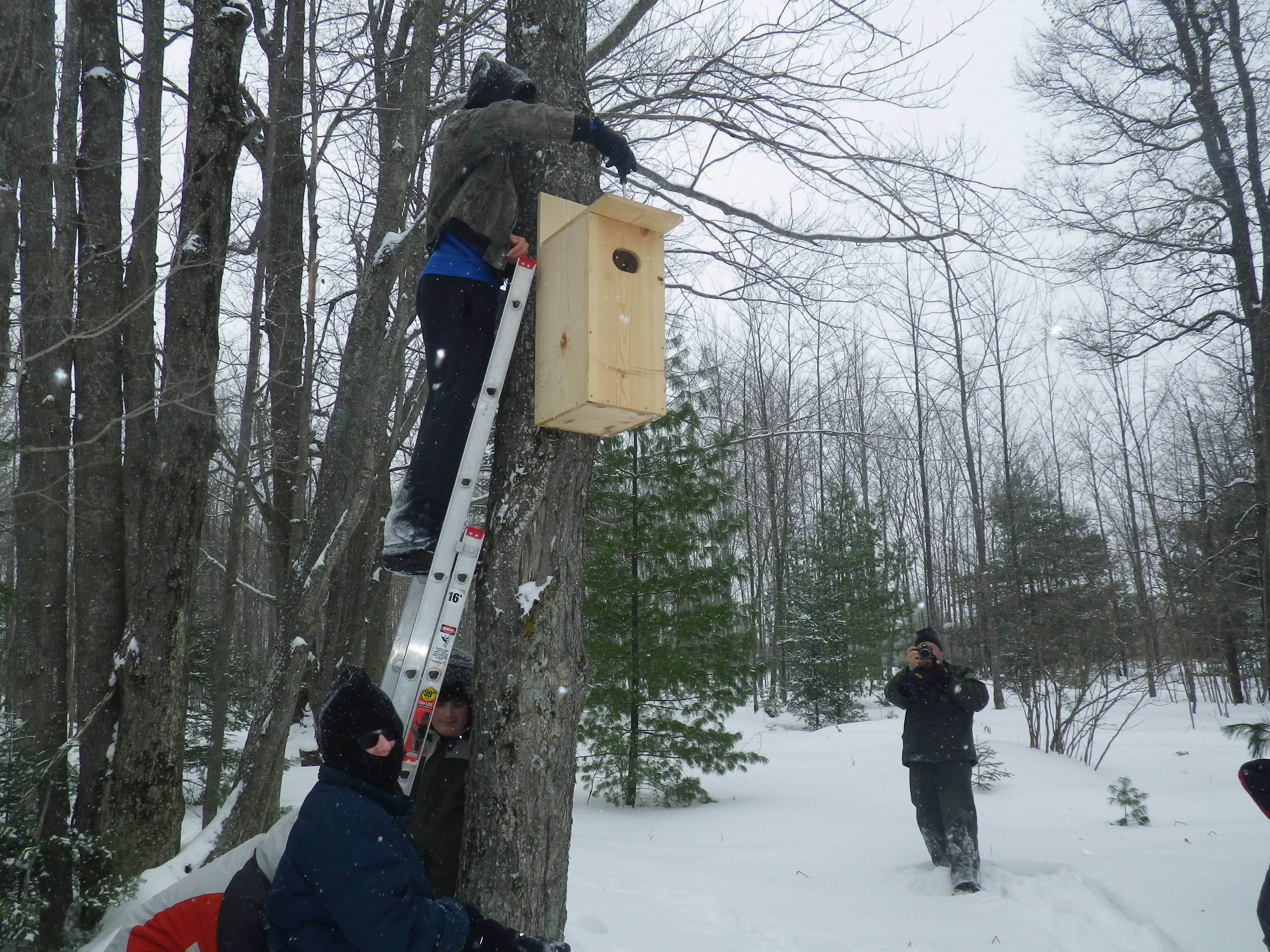
Chris Franks, a scout from Troop 602, screws on the nest box lid while Scout Joshua Hickey holds the ladder with the help of another scout from Troop 111. Photo: Susan Hickey

By Howard Meyerson

ROSCOMMON, MI — When the members of Clio Boy Scout Troop 602 met last fall to build duck nesting boxes, installing them on trees around a frozen swamp was just a distant idea. No one knew that snows would pile up and become deep; that the Michigan winter ahead would be the coldest in decades.

But February’s deep freeze didn’t slow the intrepid scouts. Excited about doing something different – a conservation project to help wood ducks – they gathered at the Backus Creek State Game Area near Roscommon and loaded up a sled with boxes and tools. Then they put on snowshoes, or planned to sink in the snow and spent a snowy, cold day installing them around the marsh.

“It was a good group. They were pretty energetic,” said Mark Boersen, the Michigan Department of Natural Resources wildlife biologist who oversees the game area and accompanied the group. “Most were willing to go up the ladder and attach a box to a tree; once in a while one needed encouragement.

“It’s been a really cold winter and the hardest thing when working with nuts and bolts, is you have to take your gloves off. By the end of the day, some of the boys were pretty cold.”

The scouts that had ventured out to do good things for ducks included seven boys from Troop 602 and two others from Troop 111, in Bay City. That they were there in snow – learning about wood duck ecology – was brainchild of Susan Hickey, mother of Josh Hickey, one of the scouts.

“I was looking for something more that the boys could do. We do normal service activities like food drives and cleaning up a park in town, but a lot of the group hunts and the conservation aspects of the project were appealing.

“I wanted the boys to do more than pick up trash on the beach. I thought it was important that they learn there are things to do to keep ducks around. It also exposed them to what a DNR guy does – not just the hunting side of the story.” Continue reading

Posted in Uncategorized | Tagged , , , , , , , | 2 Comments

Biggest Steelhead of 2013: Grand Rapids anglers makes good on the Big Manistee River

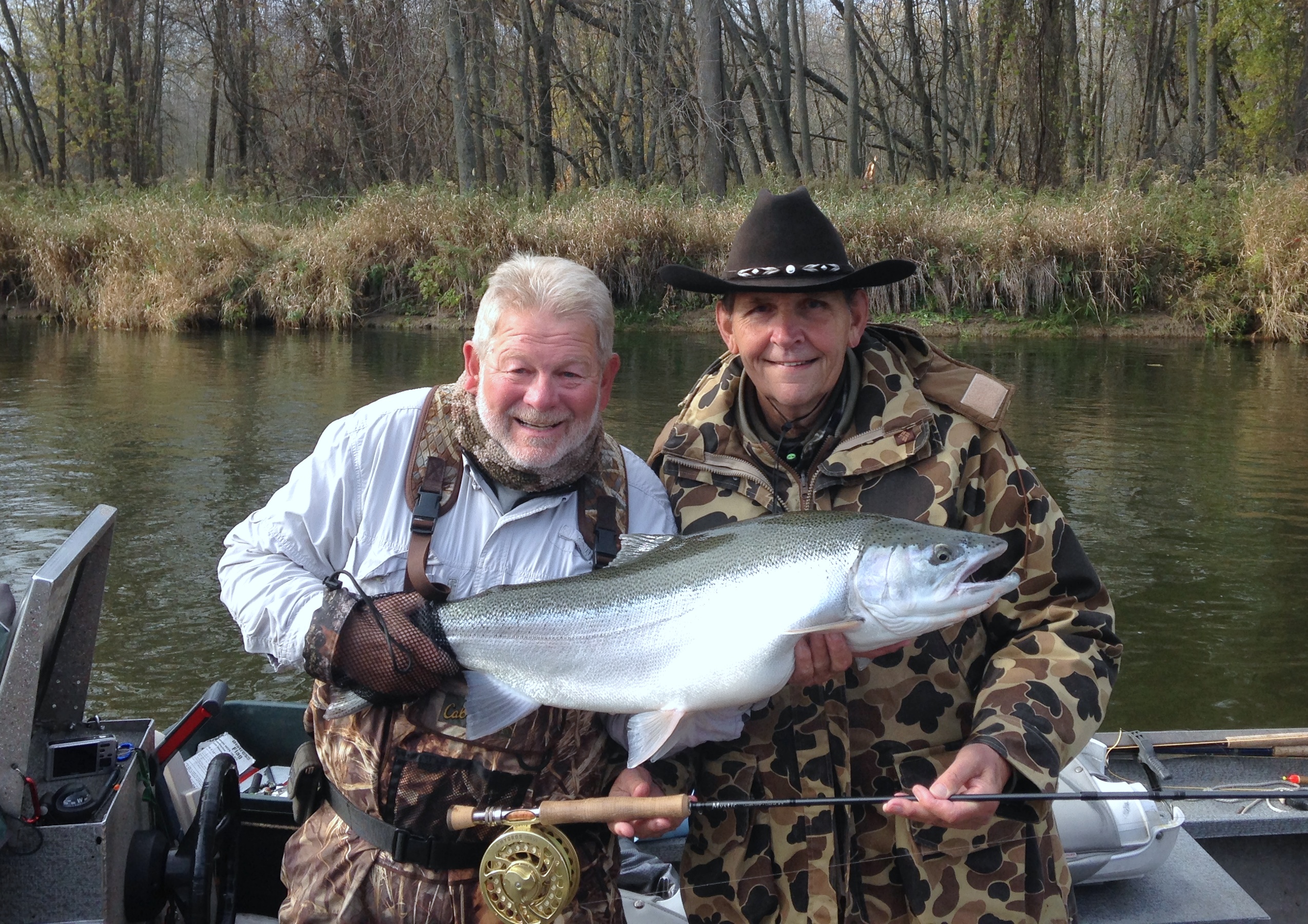
Fishing guide, Chuck Scribner (left) helps his client and friend, Bill Fuhs hold up the 38-inch steelhead Fuhs caught on the Big Manistee River last fall. (Courtesy | Captain Chuck Scribner)

Fishing guide, Chuck Scribner (left) helps his client and friend, Bill Fuhs hold up the 38-inch steelhead Fuhs caught on the Big Manistee River last fall. (Courtesy | Captain Chuck Scribner)

By Howard Meyerson

MANISTEE, MI — Their day started out like any number in late October – some wind, some sun and fish were jumping, but the bite? Well, honestly, meh.

Things could have been a lot better to hear Captain Chuck Scribner tell the story, but the 25-year veteran Manistee River guide was, in fact, fishing with one of his favorite clients and friend: Bill Fuhs, of Grand Rapids. Some call him “Big Fish Bill.”

When friends fish together there is no such thing as a bad day. Time spent on the water together is valuable – like gold. And, Fuhs, who had fished with Scribner for 18 years, had every confidence that the day would end up enjoyable, not to mention productive. What he didn’t anticipate was landing a 38-inch steelhead weighing 21-pounds, 3-ounces – the largest reported on 2013 Michigan Master Angler list in the catch and release category.

“I was absolutely surprised,” said Fuhs, who is known on the river for his trademark black cowboy hat. “We had four and half hours of nothing and then all of a sudden I hit a fish, lost it as it came at me, then cast out again and it hit.

“It started going downstream and kept fighting. They are so powerful you can’t tell for a while what you have, but it became obvious that it was something special.” Continue reading

Posted in Uncategorized | Tagged , , , , , , , , | 1 Comment

Boardman River Dam Removal Project Moves to Phase 2

The Boardman Dam will come down and Cass Road Bridge will be moved as part Phase 2. Photo: Courtesy of Theboardman.org

By Howard Meyerson

Even though deep snow now blankets most of the state, work is underway to continue restoration efforts on Boardman River. The projected $17 million to $19 million project that will result in the removal of three dams and the modification of a fourth dam is entering Phase 2, according the Boardman River Dams Implementation Team.

“Our work is progressing,” said Frank Dituri, the implementation team chairman and wetland ecologist with the Grand Traverse Bay Band of the Ottawa and Chippewa Indians. “We are in the midst of grant writing and collecting data related to removal of the Boardman and Sabin dams. That construction, or deconstruction, would most likely happen in 2015.”

Phase 2 work is expected to cost from $13 million to $15 million. It includes design work, stream studies, and replacing the Cass Road Bridge over the river, among other things. It also includes modification of the Union Street Dam in Traverse City. That dam will remain in place as a sea lamprey barrier. It is the first barrier upstream from Lake Michigan and is likely to be modified to allow some passage of lake-run fish, once decisions are made about which species to let pass. Continue reading

Posted in Uncategorized | Tagged , , , , | Leave a comment

Great Lakes muskies being stocked in new state waters

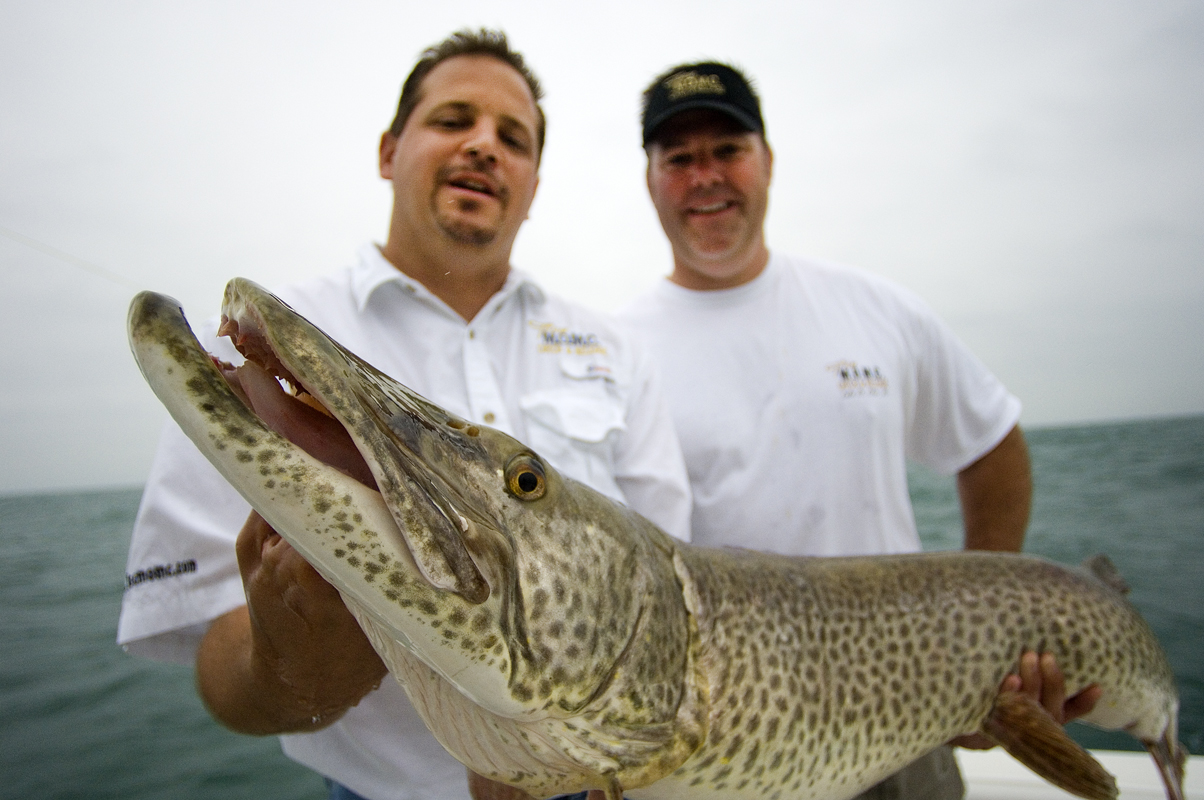
Scott D'Eath and Brad Horton with a Lake St Clair muskie. (Courtesy | Dave Kenyon, Michigan DNR)

Scott D’Eath and Brad Horton with a Lake St Clair muskie. (Courtesy | Dave Kenyon, Michigan DNR)

By Howard Meyerson

Anglers are going to see a new apex-predator swimming in certain western and northern Michigan waters in future years. The DNR is continuing to expand its Great Lakes muskie program. I suspect an increasing number of anglers will be rising to the bait.

“Being able to raise Great Lakes muskies opened up the opportunity to stock drowned river mouths and lower river systems in western Michigan,” said Jay Wesley, the DNR’s southern Lake Michigan management supervisor. “We are going into a new era with these muskies.”

You may recall that the DNR switched to raising Great Lake muskies exclusively in 2010 when the state launched its Great Lakes muskellunge program after decades of stocking northern muskies, a strain native to parts of Michigan’s Upper Peninsula.

Fisheries officials and representatives from groups like the Michigan Muskie Alliance have said the Great Lakes strain is preferable because it is indigenous to more waters and can be stocked in more places. Continue reading

Posted in Uncategorized | Tagged , , , , , , , , , | 1 Comment

CraneFest – Conserving our Sandhill Cranes!

Here is a short, new video from Michigan Audubon Society about their signature event: CraneFest. Check it out. The event celebrates the growth of the sandhill crane population in Michigan, a significant conservation success. The festival is held every October in Bellvue near Battle Creek  If you haven’t been to it put it on your calendar. It’s always a lot of fun. Here’s a link to more information about it: http://cranefest.org/

Posted in Uncategorized | Tagged , , , , , , , , | Leave a comment

Fly Fishing Film Tour returns with another great lineup

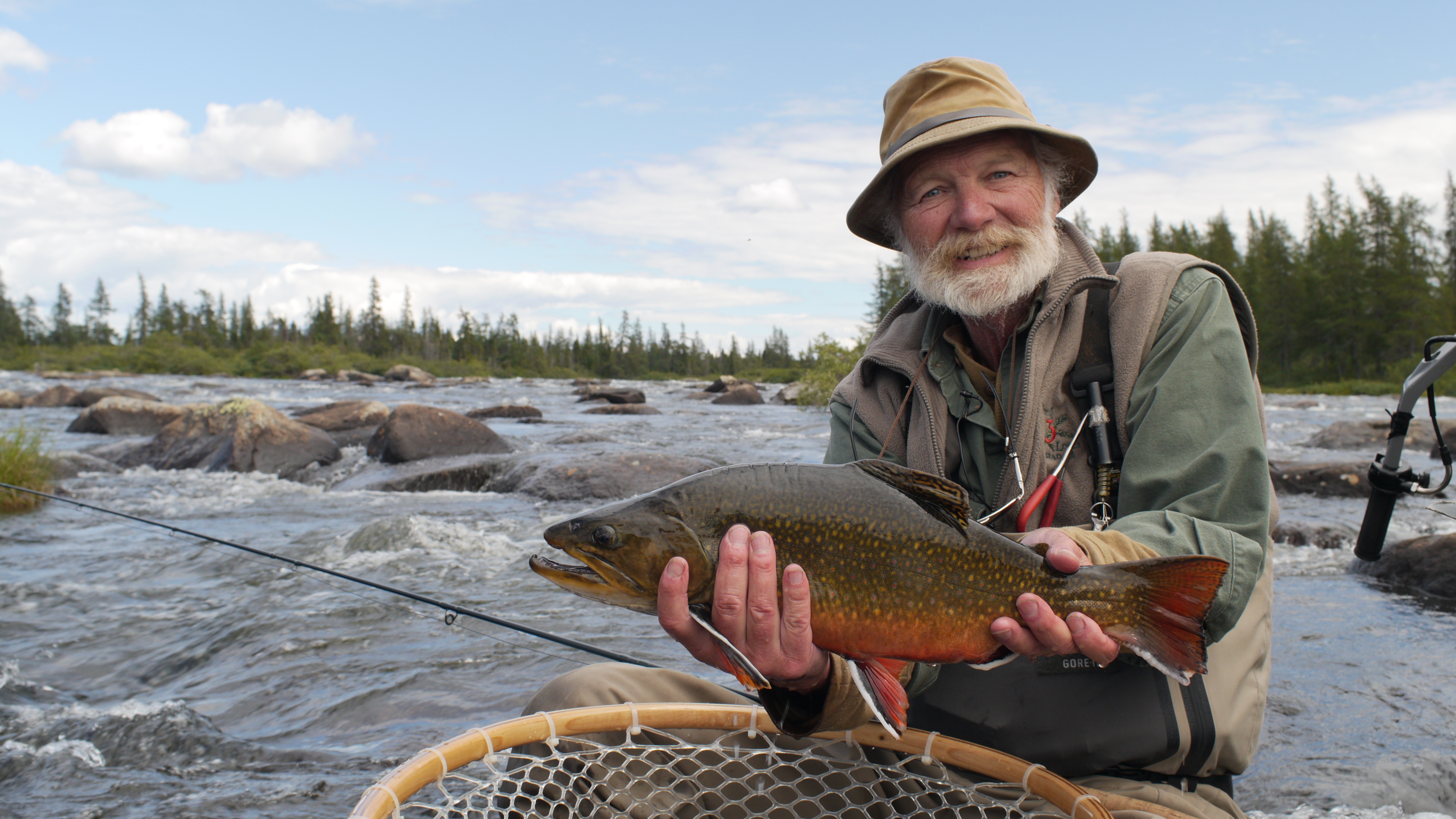
Author John Gierach calls Labrador the Center of the Spiritual Universe for Brook Trout in "North of Wild" showing in the 2014 Fly Fishing Film Tour (Courtesy | F3t Fly Fishing Film Tour)

Author John Gierach calls Labrador the Center of the Spiritual Universe for Brook Trout in “North of Wild” showing in the 2014 Fly Fishing Film Tour (Courtesy | F3t Fly Fishing Film Tour)

By Howard Meyerson

One thing that can be said about fly fishing, despite the changes in gear, clothing and tackle over the last few decades, is it often becomes a passion for those who learn its charms. Where it once drew a genteel breed to rivers edge or an off-beat lot focused on fooling trout with feather bugs, its appeal is now enjoyed by a highly colorful, discordant audience made up of men and women, young and old, rich and poor, some raucous, some reserved.

That intertwining of times, styles and passions is the delightful theme in film called “A Kinetic Loop,” by Simon Perkins. It’s one of the highlights of the 9th annual Fly Fishing Film Tour which makes its 2014 Michigan debut in Grand Rapids at 7 p.m., February 7th at the Wealthy Theatre. Subsequent showings open in Royal Oak on February 20 at the Emagine Theater, and February 28 in Ann Arbor at the Michigan Theater.

“Fly fishing (back) then didn’t have a place in society; it was such a dark art and it was practiced all by old white guys…” opined fly fishing author and Orvis fly fishing staffer, Tom Rosenbauer. He is one of a few Orvis personalities who compare now and then and contrast the eras.

“We mostly used bamboo rods then if you were serious about it and the rods were something to really treasure,” Rosenbauer continued later in the video. “The best thing about fly fishing today is what makes it polar opposite to the best thing in the 70s. Now it’s in your face; its take no prisoners; we don’t care about tradition; and its young people and a lot more visible… And so, it’s an exciting time to be around fly fishing.”

“A Kinetic Loop” is a thoughtful, fun and funky look at some of the chapters in fly fishing history, full of archival footage: that deliciously spotty filmage of yesteryear. It is one of nine films showing in the two-hour presentation that repeatedly packs the house at Wealthy Theatre.

“There is a theme this year but it is no doing of ours,” said Doug Powell, one of the principals behind the tour. “It is a kind of respect for those who have come before. It wasn’t a goal when we set out to put together this year’s show, but it just sort of happened.” Continue reading

Posted in Uncategorized | Tagged , , , , , , | Leave a comment

GoPro Sees Opportunity in Its Amateur Daredevils

The camera company is shifting from exclusively building hardware to focusing more on distributing the media that its cameras create. Photo: NYT

It’s without question that the GoPro  camera line has changed the face of outdoor videos. Anyone who searches for adventure online, whether for kayaking, fly fishing, skiing, snowmobiling or hiking is likely to find oodles of short-form videos shot with the , helmet-mounted cameras. Take a glance at Gopro’s YouTube channel and you are immediately introduced to that adrenaline-enriched world.

GoPro is now looking to become a media company, according to an article in the New York Times which reports that GoPro worked out a deal with Virgin America for a GoPro channel  on its in-flight entertainment systems. The company is working out an arrangement with Microsoft for the same on Xbox game consoles.

Read more on NYT: GoPro Sees Opportunity in Its Amateur Daredevils.

Posted in Uncategorized | Tagged , , , | Leave a comment

Harsh Winter: Supplemental deer feeding allowed in southern U.P

By Howard Meyerson

ESCANABA, MI – Heavy snowfall and bitter, cold temperatures are likely to result

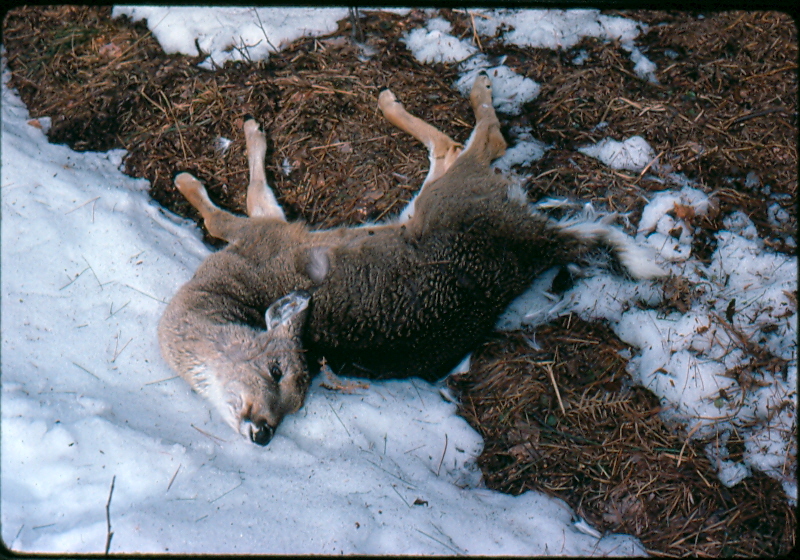
Deep snows in the Upper Peninsula are likely to result in considerable deer mortality this year. Photo: Michigan DNR

Deep snows in the Upper Peninsula are likely to result in considerable deer mortality this year. Photo: Michigan DNR

in greater Upper Peninsula deer mortality this winter. State officials, who monitor conditions there, announced in early January that that clubs, groups and individuals can now provide supplemental feed for southern U.P. deer through May 15.

“We get deer mortality every year. Even in mild winters a certain number of fawns will perish, but in a winter like this we expect a higher number of fawns will die or pregnant does will give birth to fawns with low birth weights, or still births,” said Terry Minzey, the Upper Peninsula regional wildlife supervisor for the Michigan DNR.  “Feeding mitigates the situation only to a small degree. The truth is you can’t get enough food to the deer to make a population (wide) change across the U.P., but it can impact them at the local level and let them get through the winter.”

Supplemental feeding in the southern U.P. is only allowed with a DNR permit when conditions get harsh enough – though it is allowed every year in the northern U.P. from Jan. 15 to May 15 with a permit.  Craig Albright, the DNR wildlife division field operations manager in Escanaba said this is the first winter it is being allowed in the south.  The Natural Resources Commission approved doing so in 2011, but conditions have not warranted it until now.

Snowfall in the southern U.P. has exceeded the 48-inch threshold set for allowing supplemental feeding. That means the region received more than 48 inches of snow since the start of winter. As of mid-January, 50 inches had fallen.

“If that threshold is reached by mid-January, we know from past records it will be a bad winter for deer,” Albright said. “We lose deer outright and see an impact on fawn production. Continue reading

Posted in Uncategorized | Tagged , , , , , , , | Leave a comment

Winds of Change: Further antler point restrictions proposed for Lower Peninsula

Fork-horns like this buck will have to be passed up by hunters in the Lower Peninsula if new antler point regulations are approved. Photo: Dave Kenyon, MDNR

Fork-horns like this buck will have to be passed up by hunters in the Lower Peninsula if new antler point regulations are approved. Photo: Dave Kenyon, MDNR

By Howard Meyerson

Deer hunters have a bit to think about over the next couple of months as state wildlife biologists finish gathering data from surveys sent out to just over 4,000 hunters asking if they support expanding antler point restrictions (APRs) throughout the Lower Peninsula.

Two new proposals are on the table for 2014. If approved – and that is a long way from being decided – the deer hunting landscape will change drastically in the Lower Peninsula. It is up to deer hunters to decide whether for better or worse.

The proposals were brought to the Michigan DNR by an organized group called the Lower Peninsula Deer Management Initiative. Its members support passing on smaller bucks and shooting only larger and older deer. They contend that bigger deer and healthier herds will follow – in turn, keeping hunters interested and returning to hunt. That is good for the economy and for deer hunting.

Their proposals affect the northern Lower Peninsula, what is known as Zone 2, and the entire southern portion of Michigan, known as Zone 3. APRs are now in place for 13 northwest Michigan counties and Deer Management Unit 487. The proposal would expand APR use to the rest of the NLP.

If adopted, NLP hunters would be prohibited from shooting a first deer with fewer than three antler points on a side. A second buck would have to have four points on a side, which is already required. Southern Michigan hunters would only be able to shoot deer with four points, or more, on a side. Young hunters using mentored youth or apprentice licenses would be exempt when hunting during the designated youth season. More details are available at: Michigan.gov/dnr. Type APR into the search box on top.

The change would, no doubt, be huge for Michigan – where younger bucks are the majority of what is killed. But would it result in the change that the LPDMI purports? The voices are loud on each side of the debate, but wildlife biologists are uncertain. Continue reading

Posted in Uncategorized | Tagged , , , , , | 5 Comments