Kalamazoo bowfisherman shoots state record black buffalo

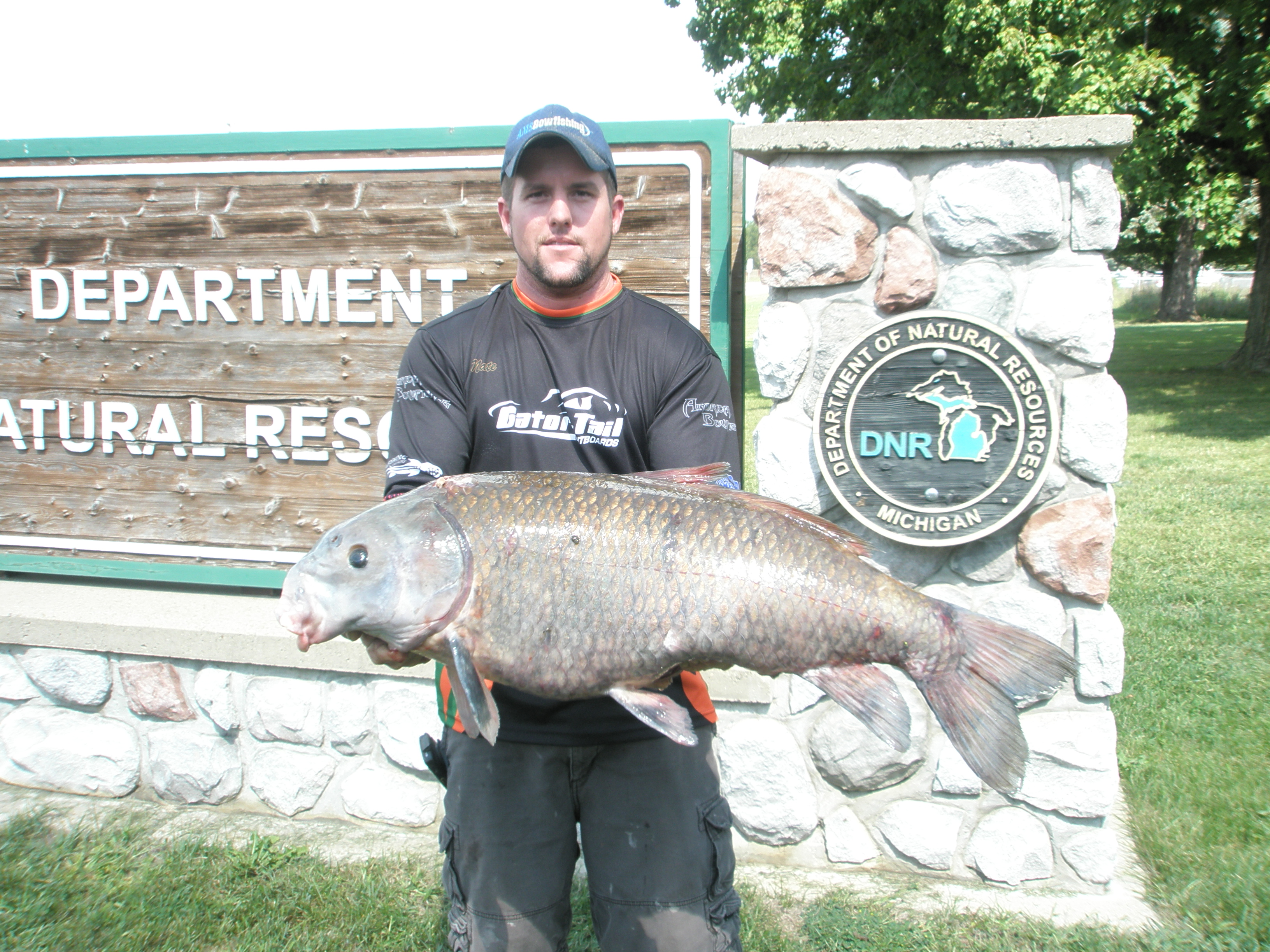
Byan DeGoede holds up his new state record black buffalo. It weighed 37 pounds, 4 ounces. Photo courtesy of the Michigan Department of Natural Resources

By Howard Meyerson

KALAMAZOO, MI — Bryan DeGoede and his buddies were cruising the backwaters of the lower Kalamazoo River shooting fish with bows and arrows, when he took aim at a black buffalo just before midnight. The big fish turned up in powerful light being used to spot them.

The 29-year-old bow fisherman from Kalamazoo let his arrow fly and quickly nailed what would turn out to be the new state record black buffalo.

“It came out of nowhere,” said DeGoede, member of Team Death From Above, a four-man competitive bow fishing team that competes in Michigan, Indiana and Kentucky tournaments. “It was a fun shoot that night, just the four of us. I didn’t think it was quite that big, and we left in the barrel overnight. Then, my buddy looked up the state
record and said: ‘We might have a state record on our hands.’”

Record indeed. DeGoede’s 37-pound, 4-ounce black buffalo measured 39.4 inches. It trounced the 33-pound, 4-ounce, 36.5-inch record shot on the Grand River in Ottawa County by Bradley James Nietering in 2004. DeGoede shot his the night of Sept. 6.

“DeGoede’s is a big fish,” said Jay Wesley, the southwest Michigan fisheries supervisor for the Michigan Department of Natural Resources. “We are seeing more of them due to the growing popularity of bow fishing. Everyone that brings one in says they are seeing bigger ones. That record will be broken again.” Continue reading

Posted in Uncategorized | Tagged , , , , , , , | Leave a comment

Changing Times: Anglers now support Lake Michigan cuts to salmon stocking

Chinook salmon is a predatory fish that feeds on alewives, below. Great Lakes natural resource managers and anglers have come up with a plan to reduce salmon stocking in Lake Michigan by 50 percent in order to avoid depleting the alewives population, which is at an all-time low. File photo: MLive.

By Howard Meyerson

My, how times have changed.

When the Lake Michigan Chinook salmon fishery crashed in 1988 because of bacterial kidney disease brought on by the stress of overstocking, among other things, anglers and charter captains were upset the state wasn’t going to solve the problem by simply putting more fish in the lake.

Today, however, they have a notably different attitude.

Anglers and state fish managers are talking more about sustainability. Better to have a steady and predictable supply of fish. Boom-and-bust cycles are costly to anglers, lakeshore communities and the state.

What is refreshingly different is that anglers, by and large, embrace the multi-state plan to cut Chinook salmon stocking in Lake Michigan by 50 percent in 2013. That plan is the result of more than a year of discussions between anglers and state natural resource managers around the lake. Twenty years ago, they would have screamed bloody murder.

“Two years ago, if they had said this, there would have been a lot of yelling and screaming,” said Bob Munch, a board member for the Southwest Michigan Chapter of the Michigan Steelhead and Salmon Fisherman’s Association, aka “The Michigan Steelheaders.”

“No one likes to get cut back, but we have to look at the long-term effect, and we realize there is a problem.” Continue reading

Posted in Uncategorized | Tagged , , , , , , | 1 Comment

Prey for Me

Photo from the US Fish and Wildlife Service

Posted in Uncategorized | Tagged , , , , | 2 Comments

Energy Efficient Camper

Found at Living Off the Grid on Facebook.

Posted in Uncategorized | Tagged , , , , | 1 Comment

Lookin for Adventure

Found at The Gear Junkie on Facebook.

Posted in Uncategorized | Tagged , , , | 2 Comments

Small game hunting in decline, but season outlook is good

By Howard Meyerson

Michigan is a destination state for grouse and woodcock hunting.

Michigan’s small game hunting seasons have opened, a date that once brought hoards of hunters to the woods. But state officials expect fewer to be hunting this season. Small game hunting is not as popular as it was once.

Small game hunting license sales have declined steadily by 2 percent a year on average since the mid-1950s. Hunters bought 256,177 small game licenses in 2011, down 1.9 percent from 2010 when 261,000 purchased them.

“It’s a long-term trend,” said Brian Frawley, the Michigan Department of Natural Resources biologist who analyzes hunting participation. “It reflects the changing popularity of those species.”

Fewer hunters are eating rabbit and squirrel these days while 90 percent go after whitetail deer, Frawley said. The shift from small game to deer began in the 1970’s as whitetail deer populations started expanding in southern Michigan.

“Deer provide hunters with more bang for the buck (than small game),” Frawley said. Continue reading

Posted in Uncategorized | Tagged , , , , , | Leave a comment

New Findings: Stink of death may keep lamprey out of rivers

Scientists have found that sea lamprey are repelled by a chemical compound that is released from lamprey when they die. Photo: US Fish and Wildlife Service

By Howard Meyerson

Scientists studying sea lamprey behavior are testing a new way to keep them out of Michigan rivers. An experiment on the Ocqueoc River by Michigan State University researchers this summer found nearly all of 350 radio-tagged lampreys avoided a stretch of river where researchers released a compound derived of dead lampreys.

The findings affirm what researchers have seen in laboratory studies so far. The study is part of an $181,000, three-year project funded by the Great Lakes Fishery Commission.

“They completely avoided the odor,” said Mike Wagner, assistant professor in the Department of Fisheries and Wildlife at Michigan State University and the lead researcher for the project. “Our prediction was they will swim on the opposite side. That is what we saw. It didn’t keep them from moving upstream, but they don’t move through it. Only one went through and we think there might have been a gap (in the scent) because of an eddy.”

Scientists call the compound an “alert-cue” or “necromone,” a chemical in the lamprey body that is released when it dies. Studies of fish have long shown similar reactions among their own, but this is the first study to focus on lampreys which rely extensively on their sense of smell. Lamprey move primarily at night when visibility is at its worst, Wagner said.

“We think the odor tells them to avoid the area,” Wagner said. “There are three circumstances that they smell dead lamprey. Those are in early migration before they spawn and it probably indicates that lamprey are being killed by predators like raccoons. It tells them they need another stream.” Continue reading

Posted in Uncategorized | Tagged , , , , , , , , | 2 Comments

Oooh, That Tickles

These two great egrets were captured in action at Harris Neck National Wildlife Refuge in Georgia. Great shot from the US Fish and Wildlife Service.

Harris Neck’s 2,762 acres consists of saltwater marsh, grassland, mixed deciduous woods, and cropland, according to the refuge webpage. “Because of this great variety in habitat, many different species of birds are attracted to the refuge throughout the year. In the summer, thousands of egrets and herons nest in the swamps, while in the winter, large concentrations of ducks (especially mallards, gadwall and teal) gather in the marshland and freshwater pools.”

Sounds like a place I would like to go.

Posted in Uncategorized | Tagged , , , , , | Leave a comment

Lightweight Haze Shaves Pounds for Backpackers

A 50-liter capacity seems awful small for a week on the trail, but there’s a lot to be said for a lightweight pack. The new Mountainsmith Haze weighs just 1.9 pounds, according to a post at Gearjunkie. If you are looking to shave pounds and aspire to go ultra-light, this may be a pack for you. Have a look.

Posted in Uncategorized | Tagged , , , , , , | 1 Comment

Craig Lake State Park Photo Gallery

This gallery contains 12 photos.

Craig Lake State Park in the west-central portion of  Michigan’s Upper Peninsula,  is referred to as one of the state’s most remote state parks. It is popular with day trippers, but far fewer come to canoe, camp and explore. All … Continue reading

More Galleries | Tagged , , , , , , | 7 Comments