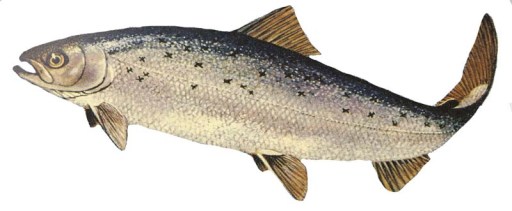
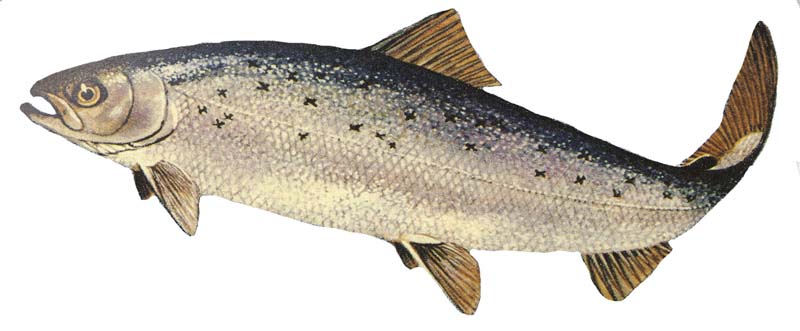
Atlantic Salmon are to be stocked in Lake Huron.
Illustration: Great Lakes Environmental Research Laboratory NOAA
By Howard Meyerson
After three-years of experimentation to determine whether Atlantic salmon can be successfully reared in state hatcheries, Michigan fisheries officials say it’s time to shift gears. The 2013 fishing season will be a bellwether of what is possible.
“We’ll have 60,000 to 80,000 Atlantic salmon yearlings available for planting in 2013,” said Todd Grischke, the Lake Huron basin coordinator for the Michigan Department of Natural Resources. “We are going into the stocking phase and will be evaluating the plants: where they go, where to best stock them and what to expect once we do.”
The decision to plant Atlantics in Lake Huron came at the urging of anglers after the 2004 Chinook salmon collapse there. Anglers knew that Atlantic salmon stocked in the St. Mary’s River by Lake Superior State University continued to thrive and return to be caught. LSSU stocks 25,000 yearling Atlantic’s annually and gets a 6 percent to 8 percent return to creel, according to Grischke.
“That return is excellent,” Grischke said. “Anything above 2 percent is good.”
Frank Krist is excited about the possibilities. He fishes Lake Huron four or five times a week and has come to favor having a multi-species fishery there. Lake trout fishing, steelhead and walleye have all exploded since the Chinook salmon disappeared due to the collapse of the alewife forage base.
“We see a lot of potential,” said Krist, chairman of the Lake Huron Citizens Fishery Advisory Committee. His group recently reviewed the DNR’s proposed Atlantic salmon stocking strategy which calls for planting them in the St. Mary’s and AuSable rivers first and the Thunder Bay River if there are enough to go around.
“When we looked at the return rate for Atlantic salmon they were five to ten times better than steelhead,” Krist said. “The Atlantics were able to adapt (to the changing food web). Continue reading →







 The Outdoor Journal